

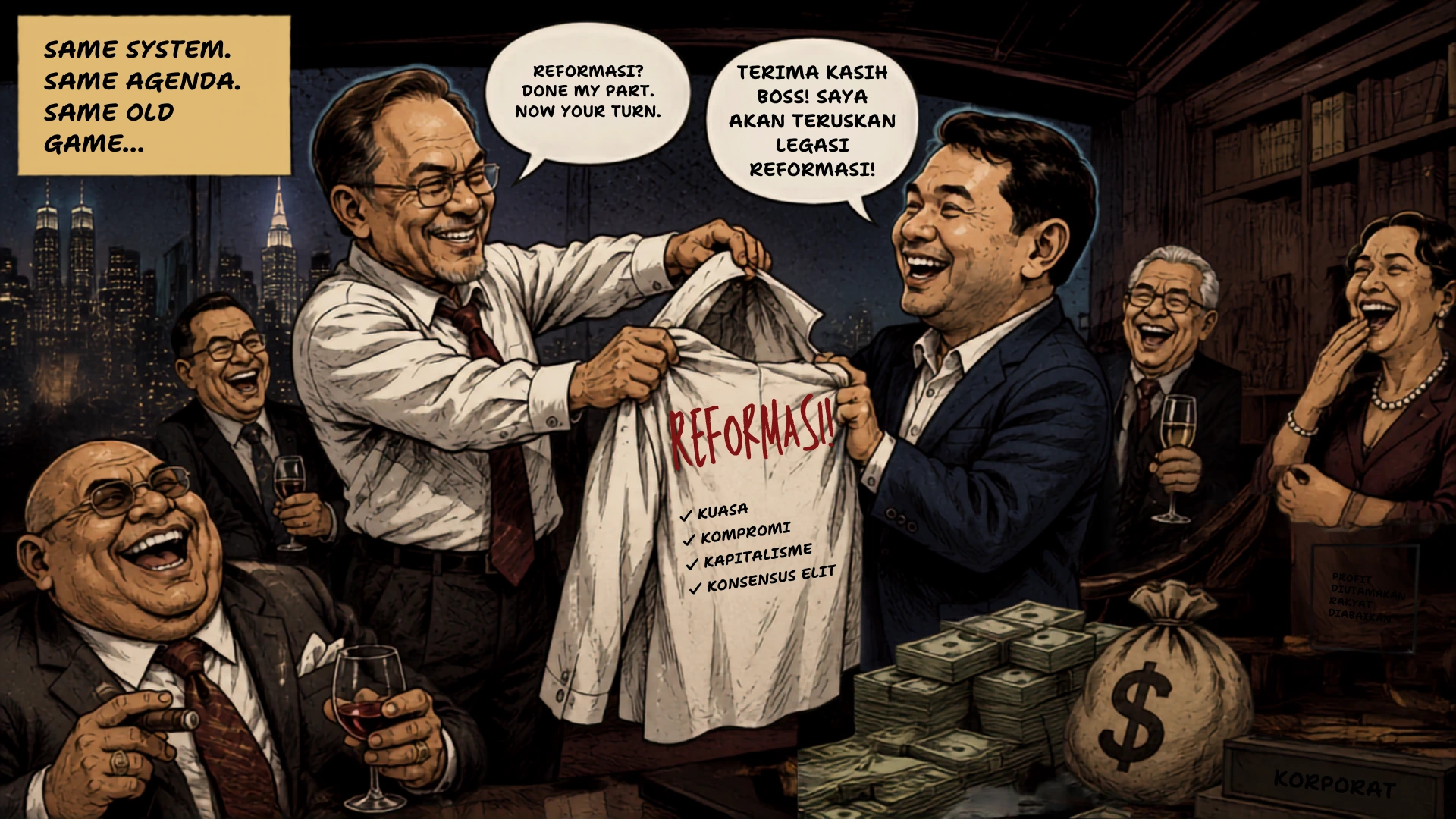
Anwar passes the old “Reformasi” coat to Rafizi, while the capitalist elites laugh along — same system, same agenda, same old game under a new face.
On May 17th, Rafizi Ramli officially announced the launch of Bersama, a new political party emerging from the growing internal crisis and factional struggle within Parti Keadilan Rakyat (PKR). From the outset, it was clear that Bersama was not born from any grassroots effort or organised pressure from below. It emerged instead from the contradictions, rivalries and power struggles within Malaysia’s ruling political establishment itself.
The speeches during the launch by Rafizi and Nik Nazmi revealed the central character of the project. Bersama is attempting to repackage and resell the increasingly exhausted Reformasi brand, presenting itself as the “true” continuation of a movement that has lost much of its credibility after years of compromise, coalition politics and failure in government. Its appeal is aimed especially at disillusioned urban youth, middle-class voters and former PH supporters who feel betrayed by PKR and the Anwar administration.
This frustration is real. Many young people are angry at rising living costs, low wages, housing insecurity, corruption, political hypocrisy and the endless betrayals of parties that once claimed to represent change. But Bersama does not offer a genuine alternative to this crisis. Beneath its rhetoric of reform and transparency, lies a familiar liberal political project – one that offers no fundamental break from the capitalist policies that produced the present crisis in the first place.
Who is Rafizi?
Rafizi Ramli has long been one of the central figures of PKR and was once celebrated by sections of the urban middle class as a symbol of “clean”, competent and technocratic reform politics. During the years of opposition, he gained prominence through his exposure of scandals such as 1MDB and positioned himself as an anti-corruption figure against the Barisan Nasional establishment.
However, Rafizi’s words and actions after entering government exposed the limits of this liberal reformist politics. As Economy Minister under the Anwar administration, he remained largely silent on controversies involving his own coalition partners, including allegations of abuse of power, corruption and political compromise within the unity government. Reformasi principles which once appeared firm suddenly became flexible once PKR and PH entered power.
This contradiction was especially clear when Rafizi defended Anwar Ibrahim holding both the Prime Minister and Finance Minister portfolios, despite PH previously criticizing Najib Razak for concentrating power in the same way. The issue is not merely one of individual hypocrisy. It reveals how liberal reformists adjust their principles according to the needs of power. What is condemned when done by the enemy becomes acceptable when done by one’s own camp.
Rafizi also represents a distinctly technocratic and neoliberal current within Malaysian politics. His solutions to economic problems consistently revolve around liberalizing the economy, reducing government spending on subsidy, privatization and so called administrative efficiency. Rather than confronting the structural power of big capital, monopolies and the profit system, Rafizi seeks to make excuses for the inadequacies of capitalism.
This approach became visible during the chicken supply crisis. Following the Ukraine war and disruptions to global supply chains, the price of imported animal feed rose sharply. Local poultry producers and major industry players pushed for higher prices while continuing to benefit from protection against foreign competition. In effect, ordinary people were squeezed between rising global costs, cartel-like behaviour and a government unwilling to seriously confront capitalist control over food production.
Instead of challenging this profiteering directly, Rafizi responded in a manner many ordinary Malaysians viewed as detached and arrogant, suggesting that consumers could reduce chicken consumption if prices became too high. The issue was not simply about chicken. It exposed a broader political instinct: when prices rise, the burden is shifted onto consumers to adapt, rather than onto corporations and monopolies that enjoyed state protection for decades. .
This is the essence of Rafizi’s politics. It is not a politics of the oppressed majority, it is the politics of technocratic management — spreadsheets, databases, subsidy rationing and market adjustment. Even when he criticizes cartels today, his politics remains trapped within the same capitalist framework that allows such monopolies to exist and dominate essential sectors in the first place.
Rafizi has also positioned himself against a clear and enforceable minimum wage approach, instead championing the so-called Progressive Wage Policy. Rather than guaranteeing workers a democratically enforced wage floor backed by strong oversight, this model leans on incentives, voluntary participation and technocratic management — leaving employers with too much room to evade real wage reform.
This is not an isolated position. It is part of a wider pattern. On wages, subsidies, prices and the cost of living, Rafizi, his circle of liberal technocrats, including the current leadership of PKR and PH which he is feuding against, have repeatedly sided with business interests and profiteering elites. Their language may be modern and reformist, but their policies consistently place the burden of crisis on workers while protecting the capitalist interests responsible for that crisis.
Rafizi’s renewed attacks on corruption, cartels and political decay also became significantly louder only after his defeat to Nurul Izzah in the PKR internal elections. Only after losing influence within the party leadership did he begin repositioning himself once again as an outsider and reformist rebel. Bersama is therefore difficult to separate from the internal factional struggles and personal political ambitions emerging within PKR itself.
Factional crisis within Reformasi
The emergence of Bersama also reflects a deeper crisis developing within the broader Reformasi and Pakatan Harapan political camp itself. Rafizi’s split from PKR is not simply an individual rebellion or personal disagreement. It may represent the beginning of a wider process of fragmentation, regrouping and leadership struggle within Malaysia’s liberal reformist establishment.
Although Bersama presents itself as a fresh political alternative, the project continues to draw sympathy and interest from sections of politicians, activists and middle-class reformist layers previously aligned with PH. Figures such as Wong Chen and other liberal-reformist personalities have shown varying degrees of openness toward Rafizi’s criticisms of the current PKR leadership, even if they have not formally broken with the coalition. This reflects growing uncertainty and dissatisfaction within parts of the PH camp itself.
Rafizi’s political repositioning must therefore be understood within the context of the unresolved succession struggle inside PKR. For years, Rafizi was widely viewed as one of the most prominent post-Anwar figures within the party. His defeat in the PKR internal elections significantly weakened that position and accelerated tensions between competing factions inside the party leadership.
Under these conditions, Bersama may function not merely as a new party, but as a possible vehicle for reorganizing sections of the liberal reformist bloc around an alternative center of leadership. Rafizi is attempting to weaken the authority of the current PKR leadership while positioning himself as a future rallying point for disillusioned PH politicians, technocratic reformists, urban professionals and younger middle-class voters frustrated with the direction of the unity government.
This does not mean such a project is guaranteed to succeed. Malaysian politics has entered an increasingly unstable and fluid period where alliances, loyalties and political calculations can shift rapidly. The same political figures who defend the current government today may seek new alignments tomorrow if they conclude that the existing coalition structure no longer protects their political survival, influence or electoral prospects. What appears stable on the surface often conceals deep contradictions underneath.
Malaysia’s political earthquake
The emergence of Bersama must be understood within the wider political and economic crisis unfolding in Malaysia. Nearly all major political coalitions — Pakatan Harapan (PH), Perikatan Nasional (PN) and Barisan Nasional (BN) — are engulfed in internal contradictions, factional disputes and declining public confidence. The instability is not confined to the liberal reformist camp. Conservative and nationalist forces such as BERSATU and PAS are also fractured, with competing personalities, tactical disagreements and weakening prospects of forming a stable majority government.
Malaysia’s political development increasingly exposes fault lines of rival factions, splinter groups, opportunistic alliances and unstable coalitions. Just as previous crises produced defections, new parties and realignments, the compounded instability of the current period is once again breaking apart the old political formations. Bersama is only one expression of this wider fragmentation.
At the root of this instability lies the deepening contradiction of the Malaysian capitalist economy itself. Official GDP figures may indicate recovery, but the lived reality of ordinary people tells a different story. Wages remain low compared to the rising cost of living. Housing is increasingly unaffordable. Young workers face insecure employment, debt, stagnant incomes and anxiety about the future. For many, the so-called post-pandemic recovery exists more in government statistics than in daily life.
Global capitalist instability is intensifying these pressures. Regional tensions, supply chain disruption, slowing global demand, volatile commodity prices and uncertainty over oil prices all place pressure on smaller economies like Malaysia. The country remains deeply dependent on global capitalism through trade, exports, finance and investment flows. It cannot escape the convulsions of the world economy.
At the same time, the MADANI government’s financial budget is fast shrinking. The government faces pressure to reduce subsidies, rationalize spending and contain deficits in order to maintain investor confidence. These policies are presented as responsible economic management, but in reality they point toward austerity. When subsidies are reduced and prices rise, it is ordinary workers and the poor who carry the burden.
These economic pressures sharpen tensions within the ruling coalition. PH and BN govern together today, but this arrangement remains fragile. UMNO seeks to rebuild its own independent strength rather than remain subordinate to PH. PN, meanwhile, faces its own contradictions between PAS, Bersatu and competing leadership ambitions. None of the major coalitions appear capable of consolidating stable long-term dominance.
Under such conditions, speculation about an earlier General Election will continue. The ruling coalition may seek elections before economic pressures worsen further, before subsidy cuts deepen public anger, and before formations such as Bersama are able to consolidate support among disillusioned voters. But an election will not resolve the crisis. It may only reproduce it in a new form, with a more fragmented parliament, confused voters and unstable alliances.
Bersama and the limits of Reformasi politics
Even if Bersama performs strongly in the coming General Election, or even in the highly unlikely scenario that it emerges as a major force in government, it would represent little more than a rerun of Pakatan Harapan 2.0. The fundamental issue is not one of individual morality, intelligence or sincerity. The problem is that parties operating within the framework of capitalism cannot resolve the contradictions produced by capitalism itself.
Rafizi and Nik Nazmi may genuinely believe they can reform Malaysian politics and rebuild public trust. But political leaders do not operate outside material conditions or class interests. Every government that accepts the framework of capitalism becomes confined by the same pressures: markets, investors, corporations, debt structures, fiscal limitations, international competition and global economic instability.
This was the contradiction that destroyed much of PH’s credibility after 2018. PH entered office with enormous public support and promises of reform. But once in government, structural transformation gave way to compromise with the ruling elites and the capitalist class. The greed and profit motives of the elite minority who control the existing political system overpowered the ‘spirit’ of Reformasi.
Bersama offers no indication that it would fundamentally break from this path. It may speak of reformation, integrity and better governance, but it does not propose to break the power of monopolies, banks, developers or big capital that is keeping our politics hostage. It offers only a better management of capitalism, which is going to have barely any impact given the current crisis the system is going through globally.
This is why Bersama must be exposed as not an alternative to the current ruling party but as just another addition to the already failing rhetoric of the so called ‘reformasi’. Its appeal will come from real anger from many young people who are feeling betrayed by PH, alienated from PN’s conservative politics, and unconvinced by BN’s attempt to revive itself. In the absence of a mass working-class alternative, even recycled reformist projects can appear fresh to layers searching for a way out.
But frustration alone does not produce political clarity. Without a socialist programme and independent working-class organization, anger can be captured by new personalities, new logos and new versions of the same failed politics. Bersama will precisely become such a vessel— not a solution to the crisis, but another attempt to redirect and manage the disappointment of the masses.
Across the world, capitalism is entering an increasingly unstable period marked by slowing growth, rising inequality, debt crises, militarization, geopolitical conflict and social polarization. Traditional parties are losing legitimacy. New parties emerge, split, rise and collapse. Political systems become unstable because the economic system that supports them is unstable.
Malaysia is part of this same global process. No capitalist coalition — whether liberal, conservative, nationalist or reformist — can offer long-term stability or genuine transformation. Rafizi, Anwar, Ahmad Samsuri and other establishment figures represent different factions within the same capitalist framework. They differ in rhetoric, style and social base, but none are prepared to fundamentally confront the power of big capital and the profit-driven logic of the system.
The crisis facing Malaysia is therefore not merely a crisis of corruption or governance. It is a crisis of capitalism itself. As long as the economy remains organised around profit, private ownership and competition, every government will eventually be forced to defend the interests of capital against the needs of ordinary people.
Turbulent times ahead — youth must be prepared
The emergence of Bersama is only one sign of the turbulent period now opening up in Malaysia. We cannot predict with certainty the exact scale, depth or timing of the coming crisis. But the major contradictions are clearly sharpening: economic pressure, political fragmentation, declining trust in institutions, youth disillusionment and growing anger among ordinary people struggling to secure their future.
As these pressures deepen, the working class may be pushed more directly into struggle. Workers, young people and the poor will not move into action because of theory alone, but because their daily lives are increasingly shaped by insecurity — low wages, rising prices, housing stress, unstable jobs and fear over the future of their families. Under such conditions, even small events can become sparks for wider social mobilization.
Different political forces will attempt to intervene in this situation. PH once channeled mass anger into electoral hope and institutional reform. Today, Rafizi, Bersama and other opposition figures are attempting to repeat the same method. They hope to capture the anger and confusion of a new generation while keeping that anger safely within the limits of capitalist politics.
The danger is not only reformist illusion. The coming period may also create sharper polarization between different communities in Malaysia. Political demagogues and capitalist parties, unable to offer real economic solutions, may turn increasingly toward race, religion, regional identity and communal fear. In moments of crisis, the ruling class often seeks to divide workers in order to avoid an united struggle from below.
Left politics in Malaysia and building an independent
Unfortunately, Parti Sosialis Malaysia (PSM), despite its positive image among many progressive youth and workers, continues to remain politically tied to the logic of liberal reformism or the so-called oxymoronic ‘progressive bourgeoisie’. Instead of using the present crisis to build an independent working-class alternative, the leadership repeatedly seeks alliances and electoral accommodation with liberal capitalist forces such as Malaysian United Democratic Alliance (MUDA). In doing so, radical anger and political energy risk being funneled back into another cycle of reformist politics rather than toward independent socialist organization and a worthy class struggle.
This is especially dangerous at a time of deepening capitalist instability and political fragmentation. The central task today should be to sharply distinguish working-class socialist politics from the failures of liberal capitalism, not adapt to them in the name of electoral pragmatism. Yet the pressure of coalition-building inevitably pushes socialist organisations like PSM to dilute demands, soften criticism and subordinate class politics to parliamentary maneuvering. At precisely the moment when political clarity and independence are most necessary, PSM leadership is choosing to capitulate to the very liberal forces which had betrayed them and the masses countless times in the past.
For this reason, youth and workers must prepare politically. Preparation does not mean anger alone. It means clear perspectives, a programme of action and the ability to intervene decisively in struggles as they emerge. Revolutionaries must be able to explain the crisis, expose the limits of capitalist parties and win the most advanced layers of youth and workers toward a socialist alternative.
The task ahead is to build a mass working-class political alternative with a clear socialist programme. Such a party must organise inside workplaces, campuses, communities and trade unions. It must also use elections and parliament as platforms to raise consciousness, expose the capitalist system and fight for concrete demands, but not as a final solution.
This requires transitional demands that connect the immediate needs of ordinary people with the necessity of socialist transformation: living wages, price controls on essential goods, public housing, free education, expanded healthcare, democratic control over key industries, and the nationalization of major monopolies under workers’ control.
Most importantly, the working class must be encouraged to rely on its own collective strength. Real change will not come from another charismatic leader, another reformist party or another promise of clean governance from above. It will come through solidarity, organization and struggle from below. Through struggle, consciousness can develop. Through organization, confidence can grow. Through collective action, workers and youth can begin to challenge the capitalist political power directly, in an organised way.
This may appear like a daunting task. But the crisis of capitalism itself will create openings for revolutionary ideas. As the system reveals its rottenness, weakness and inability to provide a secure future, increasing numbers of young people will search for alternatives. Our responsibility is to ensure that this search does not end in cynicism, divisions among the masses or another round of failed reformism, but is directed toward building a mass working class and socialist organization to usher in a new society through collective class struggle.
The period ahead demands seriousness from revolutionaries. We must sharpen our theory, deepen our historical knowledge, develop clear perspectives and strengthen our practical engagement in organising the working class. History will not wait for us to be ready. The stage is being prepared by the expanding crisis itself. The question is whether workers and youth can build the political instrument necessary to carry out their historic task — the struggle for a socialist alternative to capitalism.
Join our discussion on 31 May 2026
REFORMASI IS DEAD — Build An Independent Working-Class Alternative
PH, MUDA, Rafizi and the old Reformasi politics cannot offer a real way forward for workers and youth. Join our discussion on the crisis of reformist politics in Malaysia — and why we need an independent working-class political alternative.
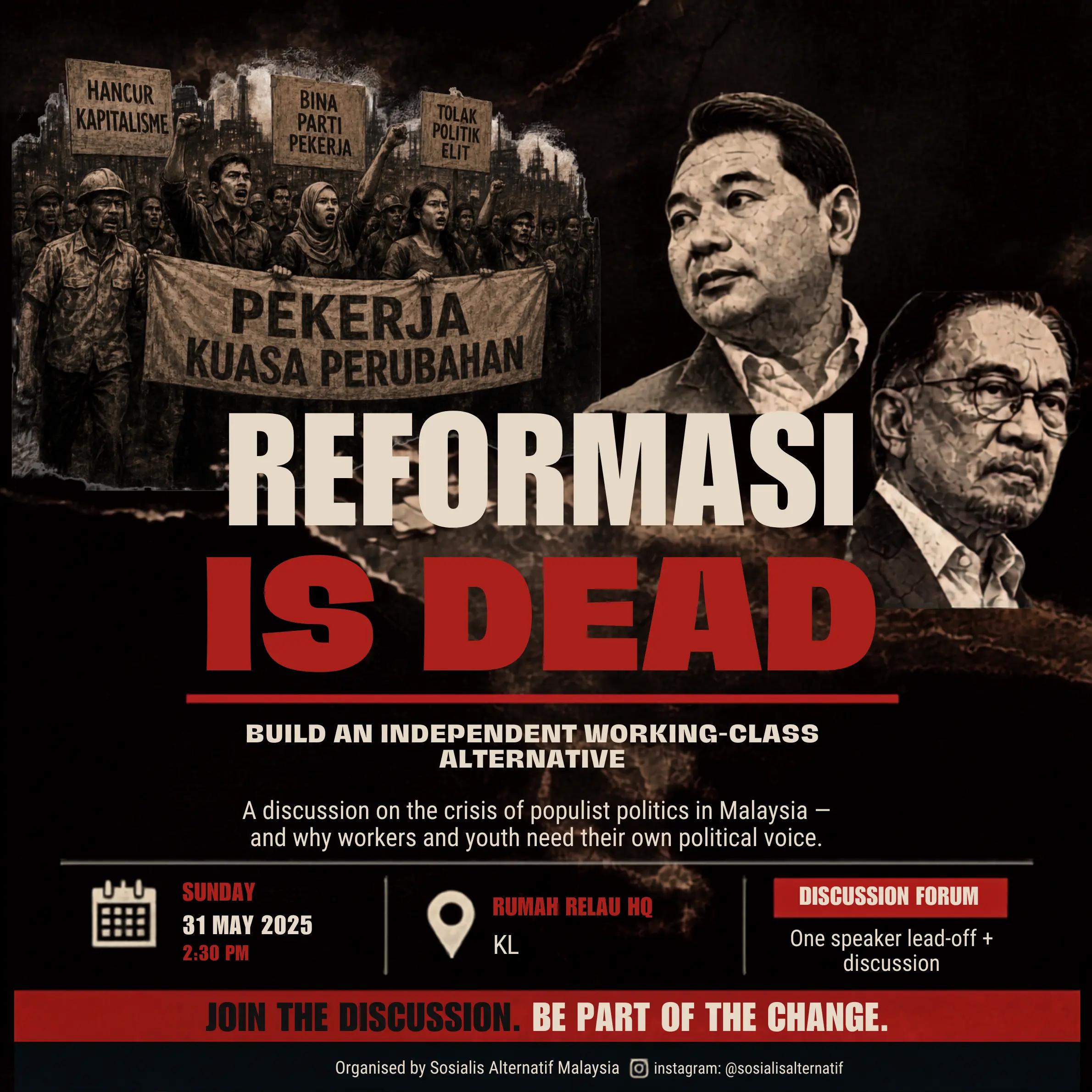
Discussion Forum
One speaker lead-off + discussion
Date: Sunday, 31 May
Time: 2:30 PM
Venue: Rumah Relau
Note: Registration required. Limited seats. Exact location will be shared after confirmation.
Register here:
https://forms.gle/qi6ExrF1WyodrNZX9
Organised by Sosialis Alternatif Malaysia
Instagram: @sosialisalternatif