

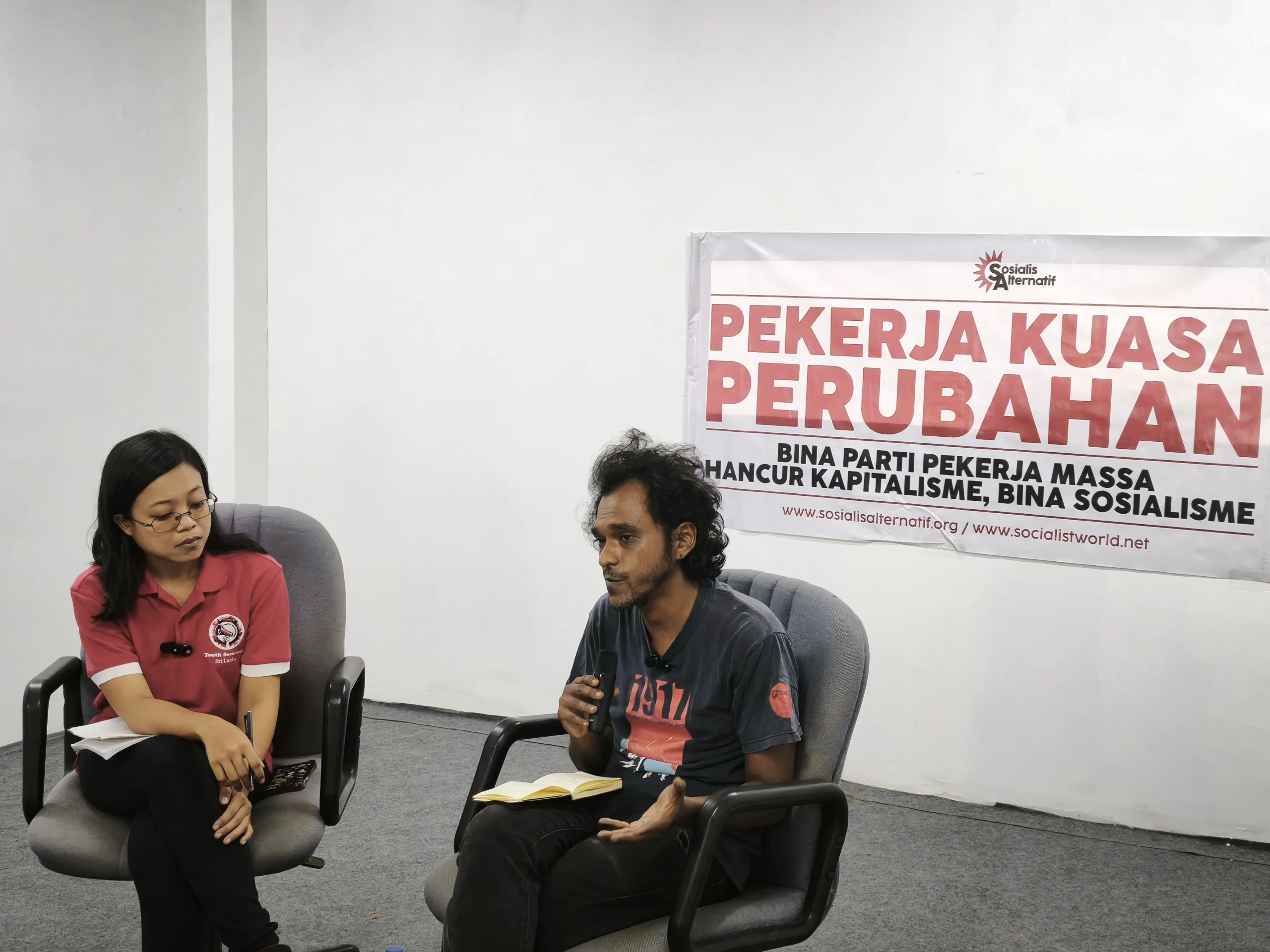
Lead-off speaker discussing the historical roots of the Reformasi movement, Rafizi’s claim to revive it, and the need for an independent working-class alternative.
Sosialis Alternatif Malaysia held a very successful public discussion yesterday under the title “Reformasi Is Dead: Build a Working-Class Alternative.” The discussion was attended by around 30 participants, marking an important milestone for our organisation. This was also the first public event held at our new organising centre, making the occasion politically and organisationally significant.
The meeting brought together members, supporters, youth, students, activists and new participants who are searching for an alternative to the dead end of liberal reformist politics in Malaysia. The discussion was lively, serious and comradely, with many contributions from the floor reflecting the growing frustration among young people and workers toward the failures of PH, PKR, MUDA and the broader liberal reformist camp.

Reformasi: From Mass Hope to Political Exhaustion
The lead-off was delivered by Yuva, who began by giving a brief historical overview of the Reformasi movement and its roots in Malaysian political development.
He explained that Malaysia’s modern political structure did not emerge naturally or democratically. It was shaped by UMNO/Perikatan in collaboration with British colonial interests, with the aim of building a racially based nation-state that could secure capitalist stability and prevent the rise of left-wing and working-class leadership.
In the early years after independence, it was not the Reformasi movement that opposed Perikatan’s conservative racial politics. Reformasi did not yet exist. The main opposition came from socialist, labour and left-wing forces, which had significant support among workers, trade unions, youth and oppressed communities. These forces represented a real challenge to the ruling class because they raised the possibility of united class struggle beyond racial divisions.
However, this left movement deteriorated due to a combination of repression, political mistakes, state attacks, demographic engineering ( by forcing Singapore out and taking in Sabah and Sarawak as part of the federation) and the strengthening of authoritarian rule. May 13, 1969, was a major flashpoint. The violence and crisis of that period were used by the conservative ruling class to consolidate a more deeply racialised political system, strengthen authoritarian state power, and push class-based politics further into the background.
After this, BN was able to maintain control for decades through a combination of racial fear, economic patronage, state repression and capitalist development. But the contradictions did not disappear.
1997 Crisis and the Rise of Reformasi
Yuva then explained how the 1997 Asian Financial Crisis became another major flashpoint. The crisis shook the whole region, including Indonesia, Thailand, South Korea and Malaysia. In Malaysia, the crisis opened up a split within the ruling class, especially between Mahathir and Anwar Ibrahim.
Out of this crisis, the Reformasi movement emerged. It expressed real anger from below: anger against corruption, authoritarianism, cronyism, police repression and BN rule. Many workers, youth and ordinary people saw Reformasi as a road toward democracy and change.
But the leadership of the movement came from a split inside the old ruling elite. PKR and the wider Reformasi movement were not rooted in an independent working-class programme. They represented liberal reformist politics, not policies which will fulfil the aspirations of the masses. Their aim was not to bring about actual meaningful change, but to ride the protest movement and secure political positions in the government.
Because BN appeared so dominant, much of the left began to gather behind the strongest opposition force. Over time, many opposition forces coalesced around Reformasi and later around PKR, Pakatan Rakyat and PH.
The Left’s Mistake and Sosialis Alternatif’s Position
The lead-off then addressed the role of the Malaysian left, particularly PSM.
Yuva explained that PSM did maintain an independent organisation and did not dissolve itself into PKR, unlike some other forces ( PRM leadership tried to dissolve their party and wholesale join PKR in 2003). This was a positive step. However, politically, PSM saw the liberal reformist opposition as a type of progressive bourgeois force that could open space for socialist politics. This led to a strategy of relying heavily on the Reformasi movement, especially through electoral cooperation.
Sosialis Alternatif Malaysia came from a current inside PSM that was fundamentally opposed to this attitude toward the liberal reformists. We argued that the working class, youth and oppressed communities needed an independent political alternative, not a strategy based on riding behind liberal forces.
We warned that the liberal opposition would eventually betray the masses. We argued that if the left tied itself to PKR, PH and the Reformasi movement, it would be dragged into their crisis. When liberal reformism failed, it would not automatically strengthen the left. Instead, it could create political confusion, demoralisation, polarisation and space for right-wing or communal forces.
This disagreement was not secondary. It was a fundamental question of political perspective. In 2008, the PSM leadership forced our current out, and we had to begin organising independently under difficult conditions.
At that time, PSM leaders were winning seats using opposition flags and gaining visibility through the wider Reformasi wave. Meanwhile, we struggled to maintain an independent left voice in Malaysian politics. We were criticised, isolated and caricatured by sections of PSM and the wider liberal reformist camp. We were called sectarian and unrealistic.
But we stood firm. We built cadres, produced political materials, expanded our outreach, and developed a clear revolutionary perspective. Most importantly, we defended the need for independent working-class politics when it was unpopular to do so.
Reformasi is Now Declared Dead
Today, Reformasi is widely declared dead. The PH government, led by Anwar Ibrahim, has not fulfilled the hopes placed in it by ordinary people. Instead, it has compromised with old ruling forces, failed to solve the cost-of-living crisis, continued capitalist policies, and offered no serious way forward for workers and youth.
In this sense, our analysis has been vindicated.
But the problem is that PSM continues to repeat the same strategic mistakes. Instead of drawing serious conclusions from the collapse of Reformasi politics, they are now entering alliances with forces such as MUDA, another liberal reformist formation with no working-class programme.
This raises serious questions. Is PSM preparing to face the same fate as before, when they spent years supporting the opposition only to be rejected and sidelined by PH? Are they again helping to give new life to liberal reformism at the very moment when young people and workers are becoming disillusioned with it?
We believe this approach only creates more confusion among youth and the masses. Instead of organising based on the independent strength of the working class, it continues to give political cover to liberal forces. Instead of helping people break from Reformasi illusions, it gives the dying Reformasi project another escape route.
Sosialis Alternatif Malaysia made it clear again during the discussion: the left must stop repeating the same mistakes without explanation, without balance sheet, and without correction. The frustration among youth is growing precisely because they can see the bankruptcy of the old strategy. Many are now looking toward Sosialis Alternatif because we offer a more consistent, logical and viable political alternative.
Contributions from the Floor
The discussion from the floor was very strong. Many participants echoed the sentiment that liberal reformism has failed and that capitalism itself is producing deeper crisis, polarisation and instability.
Several contributions touched on the destructive effects of capitalism on society: rising living costs, inequality, insecurity, exploitation and political demoralisation. Participants discussed how liberal reformist forces often herd the masses into confusion and polarisation because they promise change while remaining trapped within the limits of capitalism.
There was also discussion on the need to build a serious working-class alternative — not just as an electoral slogan, but as an organised force rooted among workers, students, youth, the poor and oppressed communities.
Youth participants also raised frustrations about the situation facing students, including the continued existence of AUKU and the failure of liberal reformists to bring meaningful change to campus democracy and student rights. The impotence of the Reformasi movement in addressing the real conditions of students was clearly felt by many young participants.
Some participants also asked broader questions about socialism, working-class politics, Sosialis Alternatif Malaysia, and how revolutionary organisation can be built in today’s conditions. This showed a serious thirst for political clarity and a growing interest in socialist ideas among a new layer of youth and activists.

Launching Our New Organising Centre
The event was also significant because it marked the first public discussion held in our new organising centre. This new space is not just an office. It is a base for political education, organising, youth work, publications, discussions, meetings, campaigns and the building of socialist forces in Malaysia.
After the discussion, we made a financial appeal to participants to help fund the new organising centre. The response was very encouraging. This appeal also marked the beginning of our wider campaign to raise the resources needed to sustain and develop the space.
At a time when many people are frustrated with mainstream politics, this organising centre can play an important role in bringing together workers, youth and activists who want to discuss, learn and organise for a socialist alternative.

The Way Forward
The discussion confirmed that a new political period is opening up. The illusions in Reformasi are breaking down. PH’s betrayal has created anger and disappointment, but also the possibility of political clarification. The key question is whether this disillusionment will lead to cynicism and passivity, or whether it can be channelled into building an organised working-class alternative.
Sosialis Alternatif Malaysia argues that the task is not to revive Reformasi. The task is to understand why it failed.
Reformasi failed because it was led by liberal reformists and capitalist politicians who could not break with the system they claimed to oppose. It failed because it did not build independent working-class power. It failed because it asked the masses to place hope in parliament, personalities and elite manoeuvres instead of their own collective strength.
Our conclusion is clear: workers, youth and oppressed communities need their own independent political organisation, their own anti-capitalist programme, their own leadership and their own struggle.
This successful first public event at our new organising centre was an important step in that direction. We thank everyone who attended, contributed, donated and helped make the discussion a success.
Reformasi is dead. The future belongs to the organised working class.