

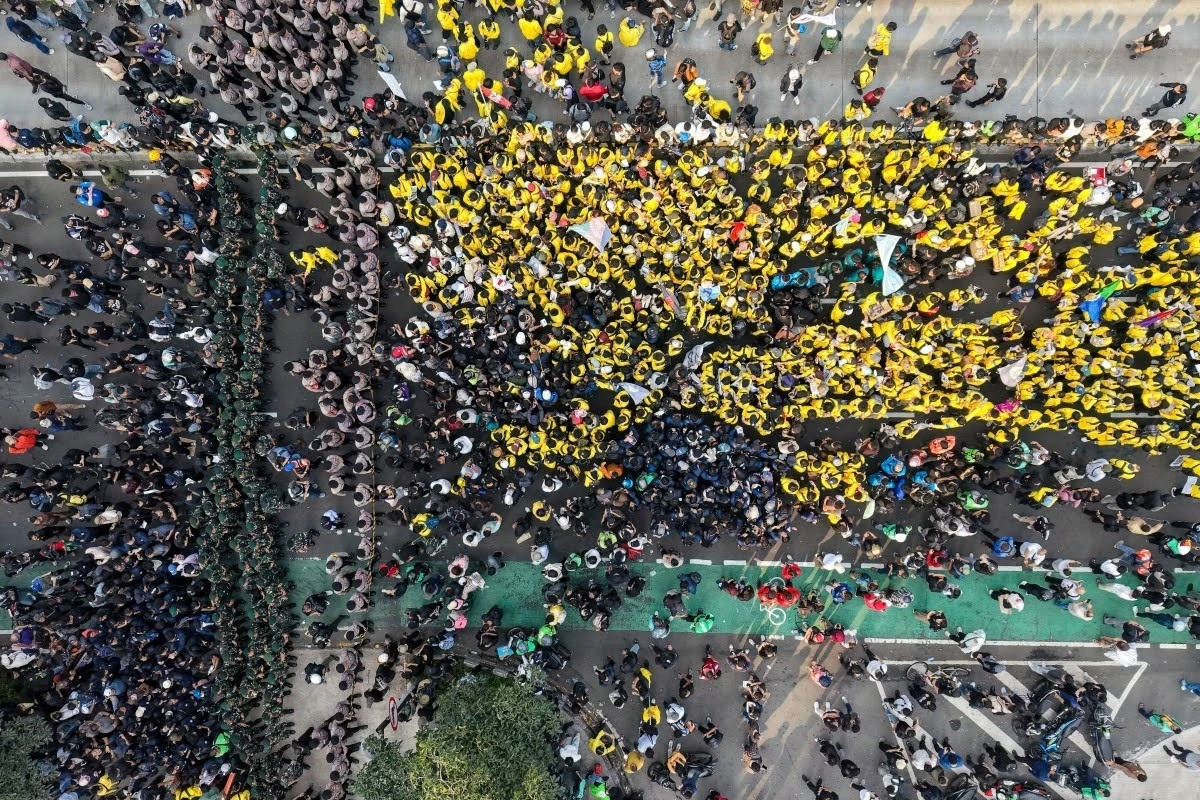
Several protests have erupted across Indonesia yet again, and given the country’s deepening economic and political crisis, it is difficult to imagine otherwise. On the 12th of June, about 1500 students took to the streets, marching towards the Hotel Indonesia roundabout in the heart of Jakarta’s main business and commercial district. The protest was primarily coordinated by several university student groups, with demands such as stopping the Free Nutritious Meals (MBG) program, the lowering of fuel and food prices, criticism of militarisation, as well as criticisms towards the government.The organisers reported that anti-riot police blocked many of the protesters from reaching the landmark. Some 6,000 police and soldiers were dispatched to suppress the groups.
Outside the capital, similar demonstrations have followed. In Denpasar, Bali, hundreds of students from multiple universities gathered outside the Bali Regional Legislative Council (DPRD), calling for a comprehensive review of the government’s “free meal” programme and broader economic reforms. Protesters questioned the allocation of significant public funds to the programme at a time when austerity measures and spending cuts are being implemented elsewhere, linking this to wider concerns about economic mismanagement and the state of democratic accountability.
In Batam, Riau Islands, the same policy became a point of contradiction. On one hand, kitchen workers employed under the free meal programme held rallies demanding its continuation, highlighting its role as a source of income and livelihood. On the other hand, students from several universities in the city staged separate protests calling for the programme to be reviewed or suspended if found to be inefficient, poorly targeted, or failing to deliver meaningful public benefit. Both perspectives point towards the same underlying issue — the lack of democratic control over public resources and economic planning.
The series of protests reflects a growing accumulation of economic and political pressures that the Indonesian state is increasingly unable to resolve within the framework of capitalism. The rupiah is at an all time low of 18000 rupiah to a US dollar. Fuel price rise while drivers report Pertalite subsidised petrol damaging their vehicles. Meanwhile, repeated austerity measures, corruption scandals, and the expansion of securitised governance add to Indonesia’s mounting social instability. When such crises intensify, political systems tend to produce leadership that reflects and manages these tensions rather than resolving them. Prabowo’s government represents a political expression of the current stage of Indonesian capitalism. These pressures are further shaped by Indonesia’s position within the global economy, where fiscal constraints and investment dependence limit the scope for structural reform. Similar dynamics are increasingly visible across Southeast Asia. From this standpoint, Prabowo is not exceptional. The recurring crises point instead to a structural problem that cannot be resolved through changes in leadership alone, but requires a transformation of the underlying system that produces them.
Every protest further exposes the hypocrisy of Prabowo’s government, a regime built upon a legacy of kidnapping, repression, and massacre. The courage of Indonesian youth who continue to confront state violence cannot be understated. Their struggle must not remain isolated. Because capitalism operates across borders, resistance to it must also extend beyond them. The youth of Malaysia, and of every country, have every reason to stand in solidarity with those fighting in Indonesia. Yet solidarity also requires drawing the political lessons of previous movements. From Egypt to Nepal, youth-led uprisings demonstrated enormous courage and determination, but courage alone could not overcome the absence of an organised working-class leadership capable of taking power. Without the organised power of the working class, capable of shutting down production and challenging the economic foundations of capitalist rule, movements risk either exhaustion or being channeled back into the existing system.
Across the globe, capitalism is increasingly stripping itself of legitimacy through the crises it produces: soaring living costs, austerity, war, ecological destruction, and authoritarianism. As millions are pushed into struggle, the decisive question is no longer whether resistance will continue, but whether it can be organised into a conscious international force. The task before socialists, is not simply to support these struggles, but to organise them. We must strengthen links between workers, students, and oppressed people across national borders, building organisations rooted in the labour movement and armed with a socialist programme. The struggle of Indonesian workers and youth is inseparable from the struggle of workers in Malaysia and throughout the world. International solidarity is not simply a moral principle, but a practical necessity. Only the organised power of the international working class can replace a system built on exploitation with one based on democratic control, social ownership, and human need.