

Military Rule, Workers’ Resistance and the Fight for Democracy
Myanmar’s history of military rule
Myanmar has been dominated by the military institution known as the Tatmadaw for most of its history since independence. There was limited political opening in 2011, followed by the National League for Democracy’s (NLD) first win in the 2015 elections. The NLD’s following landslide victory in 2020 against the military-proxy Union Solidarity and Development Party (USDP) reflected widespread opposition to continued military domination and support for democratic demands.
Despite this, the regime baselessly alleged electoral fraud, using it as justification to enact a coup d’état less than three months later in February 2021, where they arrested NLD party leader Aung San Suu Kyi and sentenced her to 27 years in prison. Her sentence was later reduced through amnesties in April 2026. The military effectively dissolved the party and established the State Administration Council (SAC) as the de facto governing authority.
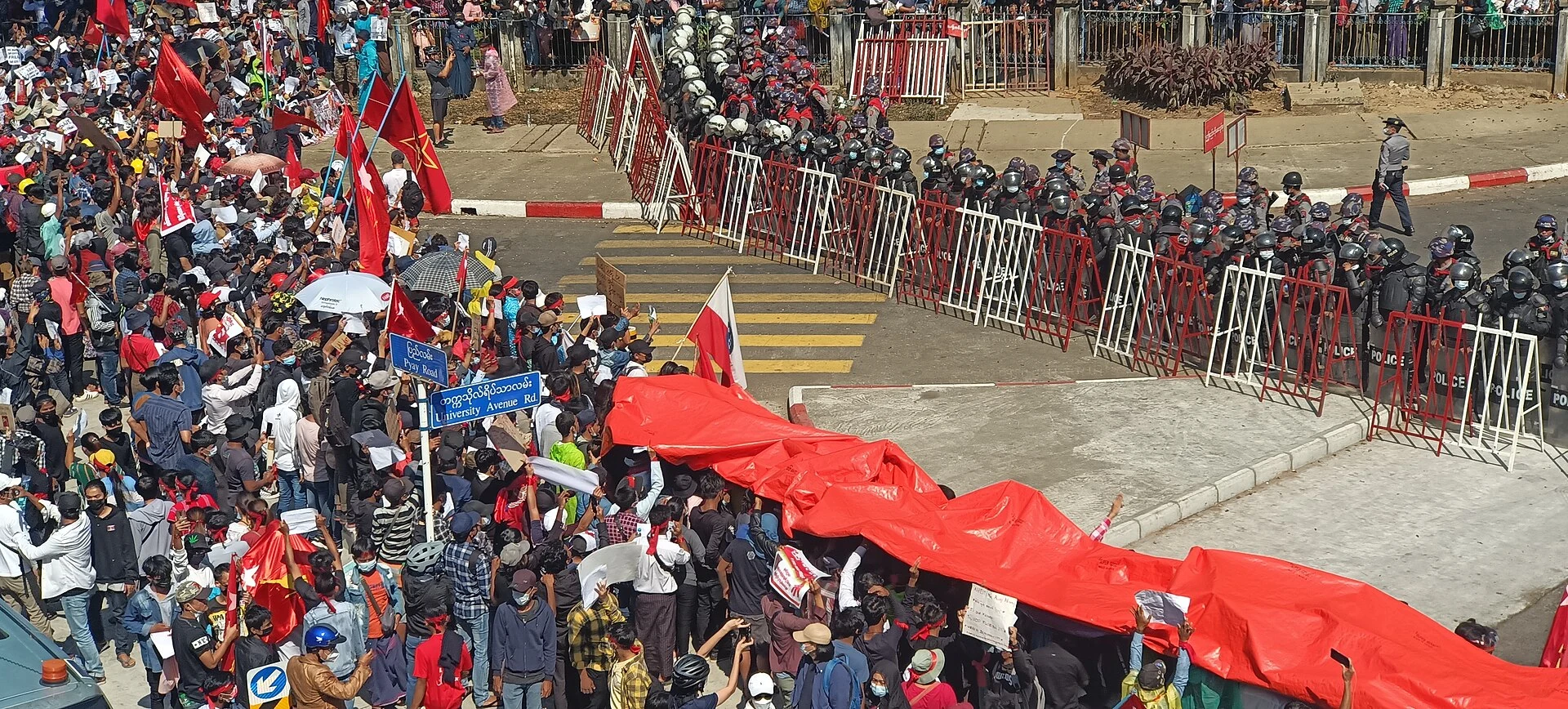
This sparked the Civil Disobedience Movement (CDM), spearheaded by health workers and civil servants, that grew into a country-wide movement in opposition to the junta. From railway to garment workers, hundreds of thousands took to the streets throughout the month of February, paralysing swathes of industries through general strike action.
The military unsurprisingly responded with violent measures to crush the protest movement, involving but not limited to mass arrests, torture, and extrajudicial murders. Resistance forces such as the People’s Defence Force (PDF) and ethnic armed organisations emerged out of this conflict and engaged in armed struggle with the junta over territorial control across roughly half of Myanmar.
The CDM demonstrated that workers possessed a source of power unavailable to any parliamentary party. By withdrawing their labour, they disrupted transport, healthcare, education and state administration, briefly raising the possibility that the junta could be challenged through organised mass action.
Fast forward four years later to late 2025, amidst the civil war, where the SAC chose to hold another general election; one that has many layers worth dissecting.
The recent sham elections
Myanmar’s most recent general election concluded in January 2026, with the military-proxy USDP winning an overwhelming majority of the contested seats.
The election has, however, been widely dismissed as fraudulent, with main concerns citing the military’s rebrand of its governing body from the State Administration Council (SAC) to the State Security and Peace Commission (SSPC), which oversaw the elections under this new name.
Local media reported instances of intimidation by local administrators and pressure on workers and residents to participate in election-related registration activities. This, along with the withholding of elections in townships they did not have control over, the dissolution of opposition parties, and the criminalisation of speaking out or “inciting” against the polls, showcases the regime’s structural manipulation to ensure a predetermined election outcome.
China and Russia, who have long supported the junta in pursuit of their economic interests, were also reported to have sent election observers to the polls.
In April 2026, the military-dominated parliament subsequently elected coup leader Min Aung Hlaing as president, completing the regime’s attempted transition from direct military rule to a civilian constitutional façade.
Failures of the NLD
Why was the Tatmadaw able to enact the 2021 coup and reassert military rule over Myanmar?
Under the 2008 Constitution drafted by the military, the Tatmadaw retained control over key ministries, a guaranteed bloc of parliamentary seats, and extensive economic interests, severely limiting the scope of civilian governments.
When the NLD came into power, it failed to challenge the military’s dominance or amend the 2008 Constitution despite a clear public mandate. This strategy of non-confrontation and cooperation with the military played a critical role in preserving the Tatmadaw’s structural power.
Aung San Suu Kyi even went so far as to defend the military’s ethnic cleansing of the Rohingya population on the international stage.
Accommodation with the military and failure to dismantle the Tatmadaw’s entrenched power left its constitutional, political and economic power largely intact and in a position to reassert direct rule when its interests were threatened.
Why did the military hold an election?
If the regime never planned on having an actual democratic election, why bother hosting the election at all, let alone waste so many resources coercing citizens to vote for them?
Following the coup, the regime found itself facing a multitude of crises, from military to economic to diplomatic, that severely weakened its grip on power and ability to sustain its reign.
As civil war ensues, the regime, met with mass soldier defections and difficulty recruiting new ones, has lost effective control over large parts of Myanmar’s territory to resistance organisations.
There is also the matter of international sanctions against the SAC, which caused the suspension of aid, prompted investor withdrawal, deterred new foreign investment, and disrupted international trade. These sanctions exacerbated the regime’s economic difficulties, forcing it to deepen its dependency on China and Russia for weapons and aid.
This is what led to the most recent ‘sham election’: an extension of the deployment of authoritarian measures by the Tatmadaw to remain in power.
The regime’s rebranding from the SAC to the SSPC and its coercive election were aimed at presenting itself as a constitutional civilian authority to seek greater domestic and international legitimacy, while creating opportunities to weaken diplomatic isolation and encourage renewed economic engagement.
Myanmar’s hope
Despite enormous resources devoted to repression and electoral coercion, the regime failed to secure genuine popular legitimacy. Only 13.1 million votes were cast during the 2025–26 elections, an abysmal turnout compared to the 25.9 million in 2020. An estimated 11 million people boycotted the election entirely despite threats.
The Burmese youth especially, having gotten to experience greater political freedoms and been instilled with expectations of further democratic reform during the brief success of the NLD, refuse any form of political domination by the military, and their determination to oppose and strip the Tatmadaw of its power only continues to grow.
Meanwhile, ousted elected officials of the NLD and pro-democracy forces have come together to form the National Unity Government (NUG), referred to as Myanmar’s shadow government, operating from abroad and from resistance-held areas.
While many of the Myanmar youth and workers consider the NUG the only representative body available, they do not do so uncritically. The NUG faces significant criticism, stemming largely from the failures of the NLD’s governing.
Concerned with past acceptances of power-sharing agreements, youth activists have sworn not to make any compromises when it comes to stripping the military of power.
There is also a perceived disconnect of the NUG from grassroots movements, with youth who led early mass strikes and demonstrations feeling that their demands for social and economic transformation are subordinated to the NUG’s “stagist” strategy to restore the previous parliamentary democracy before pursuing broader social transformation.
This time, the youth have social demands broader than simply the restoration of the pre-2021 order. In spite of all attempts to muddy what true democracy looks like, they remain sharp and critical of those who claim to represent them.
Their rejection of the regime and dissatisfaction with the NUG reveals an important process of political radicalisation, though it has yet to find cohesive organisational expression.
International response
While the UN, ASEAN, and governments of a few countries refuse to recognise the 2026 election results, Myanmar citizens still express disappointment with the international community, stating that while the UN condemns the regime, its “strongly worded letters” don’t result in any concrete action being taken.
Similarly, ASEAN countries prioritise economic and financial ties over human rights. Citizens noted feeling abandoned and isolated by neighbouring countries.
While the governments of China, India and Russia express technical and political support towards the SSPC in pursuit of economic benefit, those that reject the recent election results, such as the US, EU, UK and Japan, do so too primarily in pursuit of the interests of their own capitalist ruling classes.
Trade sanctions too disproportionately affect workers and the poor as heavy costs are imposed onto them, while sections of the military and business elite are able to cushion themselves through control of natural-resource revenues, informal trade networks, and regional financial connections.
Moving forwards
The crisis in Myanmar has shown both the brutality of military rule and the limits of relying on liberal-bourgeois forces to complete the democratic struggle.
The NLD failed to dismantle the military’s economic and constitutional power, while the NUG’s strategy remains largely focused on restoring the pre-coup order rather than transforming the social conditions that produced repeated military domination.
While the youth hold no illusions of reform and are able to see past racial and ethnic division, the central question remains how workers, youth, and oppressed ethnic communities can build independent organisations capable of coordinating the struggle across the country.
A socialist programme that combines democratic rights, land reform, public ownership of key industries, and genuine self-determination for ethnic minorities would provide a stronger basis for unity than appeals to national reconciliation under capitalism.
Growing dissatisfaction among rank-and-file soldiers also creates openings to undermine the junta from within. Calls for democratic rights, amnesty for defecting soldiers, decent living conditions, and an end to being used against their own communities, addressing their material conditions, can help win ordinary soldiers away from the military leadership.
The working class possesses the power to paralyse the economy through mass industrial action due to its role in production. The experience of the CDM showed the potential power of organised workers.
The task ahead is to transform that potential into lasting political organisation capable of leading the struggle against military rule and capitalism alike.
The working class holds the potential to unite the oppressed across ethnic divisions and effectively meet the needs of everyday citizens through seizing the means of production. This underlines the need for an independent revolutionary workers’ party capable of linking democratic demands with socialist transformation.
The struggle against dictatorship in Myanmar cannot be separated from the struggle against the capitalist system that sustains military elites, multinational corporations, and competing imperialist powers.
Only the independent organisation of workers across borders offers a path towards genuine democratic and social liberation.