

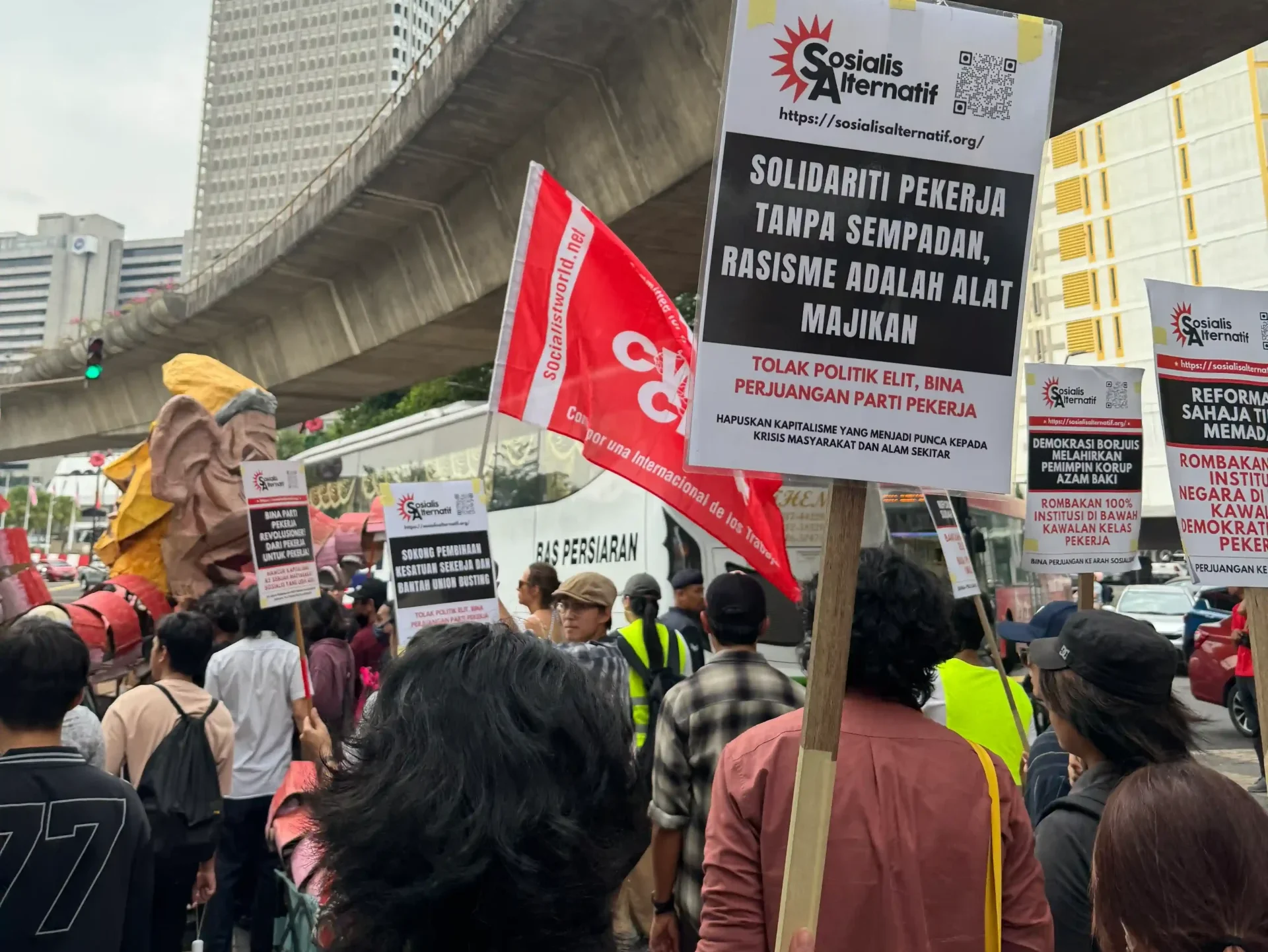
Sosialis Alternatif contingent marches in Kuala Lumpur on Labour Day 2026, holding placards and bearing the flag of the CWI (Committee for a Workers’ International).
Baca versi Bahasa Melayu di sini.
On this year’s International Workers’ Day, the global working class is facing a deepening crisis of capitalism alongside escalating geopolitical tensions. Wars and armed conflicts continue to spread from Palestine, Sudan and the Democratic Republic of Congo to Myanmar, while the threat of a wider world war is becoming increasingly real through the wars in the Middle East and Ukraine. Millions of workers and poor people have become victims of war, forced displacement, famine and worsening poverty. At the same time, the cost-of-living crisis, attacks on workers’ rights, unemployment, debt crises and austerity policies continue to burden the lives of ordinary people in almost every country today.
In this situation, the ruling class and capitalists who dominate the global economy have failed to offer any meaningful solution for the masses. Instead, they continue implementing austerity measures that erode public services and worsen the conditions of working people, while using state institutions and machinery to protect corporate profits and preserve elite interests.
It is within this context that May Day 2026 takes place, as a symbol of the international struggle of the working class against a capitalist system that is driving the world toward crisis, war and social instability.
Labour Day March — 1 May 2026
This year’s march was attended by layers of youth and ordinary people from various backgrounds and struggles. Hundreds participated, carrying demands and slogans reflecting their respective causes.
Among the groups that deserve mention were the activists from Batu Arang opposing the construction of an incinerator near their residential area. Their struggle has continued for many years without any solution that genuinely serves the people. There were also agricultural workers demanding land rights, university students opposing bureaucratic repression within educational institutions, youth fighting for the rights of interns, gig worker organisations demanding recognition of their rights as workers, and many others.
Representatives from grassroots movements, youth groups and workers were also given the opportunity to deliver speeches filled with passion and reflecting the real anxieties currently faced by society.
Among the participants were youth groups carrying banners demanding free education, the abolition of the repressive AUKU Act, improvements to public healthcare facilities and various other progressive demands. At the same time however, there were also reformist slogans that did not go beyond the framework of capitalism itself and merely proposed administrative reforms without challenging the economic power of the ruling class.
Although anti-corruption struggles under the banner of reform are legitimate demands supported by many people, past experience teaches us not to accept the liberal reformist leadership blindly. The Pakatan Harapan government itself championed the slogan of reform for nearly two decades before betraying the hopes of the masses once it obtained state power.
The same question therefore arises once again. Should the people once more place their hopes in liberal figures who merely promise administrative reforms while refusing to address the capitalist economic system that is driving the working class toward poverty, debt and misery?
Where are the revolutionary calls that recognize that capitalism not only creates war and instability globally, but also produces inflation, unemployment, democratic decline and numerous social crises that increasingly burden ordinary people in our country today?
Between Reformism and Working-Class Politics
The efforts of the organizers who have consistently organised this event over many years should certainly be appreciated. They have succeeded in bringing together people from various backgrounds with a shared desire for positive social change. At the same time, the organizers stressed that May Day should not remain trapped within trade union bureaucracy alone, but must move toward broader political questions.
This position deserves attention. However, the political direction of such change must also be examined critically. The existing trade union bureaucracy has long exposed itself as incapable of seriously leading workers’ struggles. Much of this leadership has become increasingly detached from the realities faced by workers and more inclined toward compromise with the government and capitalist class.
Nevertheless, criticism of trade union bureaucracy should not be extended to reject the rank and file workers within those unions themselves. On the contrary, the workers’ movement requires greater participation from grassroots activists and mass political organisations in order to build a more militant struggle rooted in the interests of the working class. It is precisely at moments like this that the organizers, especially PSM, should raise working-class demands and offer independent political leadership to struggling workers.
However, within the list of demands put forward by the organizers, it was clear that immediate working-class needs and demands were not given sufficient emphasis. Instead, broad slogans such as anti-corruption and anti-imperialism were highlighted more prominently than economic demands capable of mobilizing broader mass participation from the working class.
The same concern was raised by a trade union member who attended the event in an individual capacity. He expressed disappointment that the organizers had failed to call for mass worker participation through demands directly connected to workers’ daily lives. In fact, during this year’s May Day mobilization, there was not even a concrete demand regarding the minimum wage, despite wages, inflation and the cost of living being among the most urgent issues facing the majority of people today.
PSM and MUDA
The absence of clear working-class demands was not merely a technical weakness, but a political consequence of the coalition built by the organizers themselves. When left organisations choose to adapt themselves to liberal reformist parties such as MUDA, the demands of the movement inevitably become diluted so as not to exceed the political limits of capitalism.
The reality is that ordinary people are increasingly distrustful of reformist politics filled with slogans of change and sweet promises without any genuine willingness to challenge the economic structures and class power of the ruling elite. Previously, Pakatan Harapan successfully gained public support through reformist rhetoric, only to continue policies defending capitalist and elite interests once it entered government. Today, parties such as MUDA together with liberal figures like Rafizi Ramli are attempting to fill the existing political vacuum through a similar approach — presenting a progressive image without offering any economic or political alternative genuinely aligned with the interests of the working class.
In this situation, an important question must be raised: why does PSM still choose to build political alliances with liberal reformist forces that clearly operate within the framework of capitalism? Throughout its history, PSM has often placed hope in alliances with liberal reformists as a means of opening democratic space and bringing progressive change for the people. Yet previous political experience has repeatedly shown that such strategies ultimately lead only to political compromise and betrayal of popular aspirations.
Unfortunately, the same approach continues today without any serious critical reassessment of its weaknesses. In the context of this year’s May Day, the effects were clearly visible when working-class economic and political demands failed to receive sufficient emphasis, while broad reformist slogans more aligned with the political style of liberal capitalist forces such as MUDA became the central focus.
MUDA is attempting to build political influence by presenting itself as the voice of youth and progressive change. In reality however, the party does not represent the true aspirations of the masses. Instead, it remains firmly within the boundaries of liberal capitalism that preserve the exploitation and oppression of the working class. Under such circumstances, the decades-long sacrifice and fighting tradition built by PSM is at risk of being used to legitimize a reformist political project that ultimately cannot provide any real solution to the problems faced by the oppressed masses.
PSM should instead utilize its strength to build an independent and principled working-class political alternative, rather than remaining trapped in alliance-building strategies with liberal leaderships whose class interests fundamentally differ from those of the working class.
Socialist Alternative and Labour Day
In conditions of such political confusion, the task of revolutionary Marxists is not to adapt themselves to the currents of liberal reformism, but to bring forward a clear, principled and independent working-class political perspective. It was on this basis that members of Socialist Alternative participated in this year’s May Day march, bringing forward a socialist programme and the perspective of building independent working-class political power.
We built our own contingent composed of politically conscious youth actively struggling against the political domination of the capitalist class and committed to building independent working-class power. We carried the main banner reading “Workers Are The Power for Change” alongside placards declaring “Reform Politics is Dead — Time To Build Working-Class Politics.”
At the same time, we raised a concrete demand for a RM20 hourly minimum wage in order to win support from workers, together with other economic demands such as price controls, democratic workers’ administration over the country’s natural resources and more.
The main purpose of our intervention in this event was to raise political consciousness among the youth and workers participating in this year’s May Day mobilization. We sought to present an alternative path beyond opposition politics and liberal reformist leaderships which are already politically bankrupt. Through newspapers and leaflets, we called upon participants to join hands with us — together with youth movements, workers and grassroots struggles — in building a political leadership that truly represents the aspirations of the working class and is prepared to challenge the political domination of the capitalist class.
We brought forward the idea of a socialist future, fought for together with workers and the masses — a future that places the interests of the majority above those of the capitalist minority. In contrast to capitalism, under socialism, all administrative power and control over the country’s resources and economy would be placed under the democratic control of workers and ordinary people. Those who produce the wealth and resources of society would also possess the power to democratically distribute that wealth for the development of society as a whole. This represents the only real way out of the destruction being created by capitalist leadership today.