

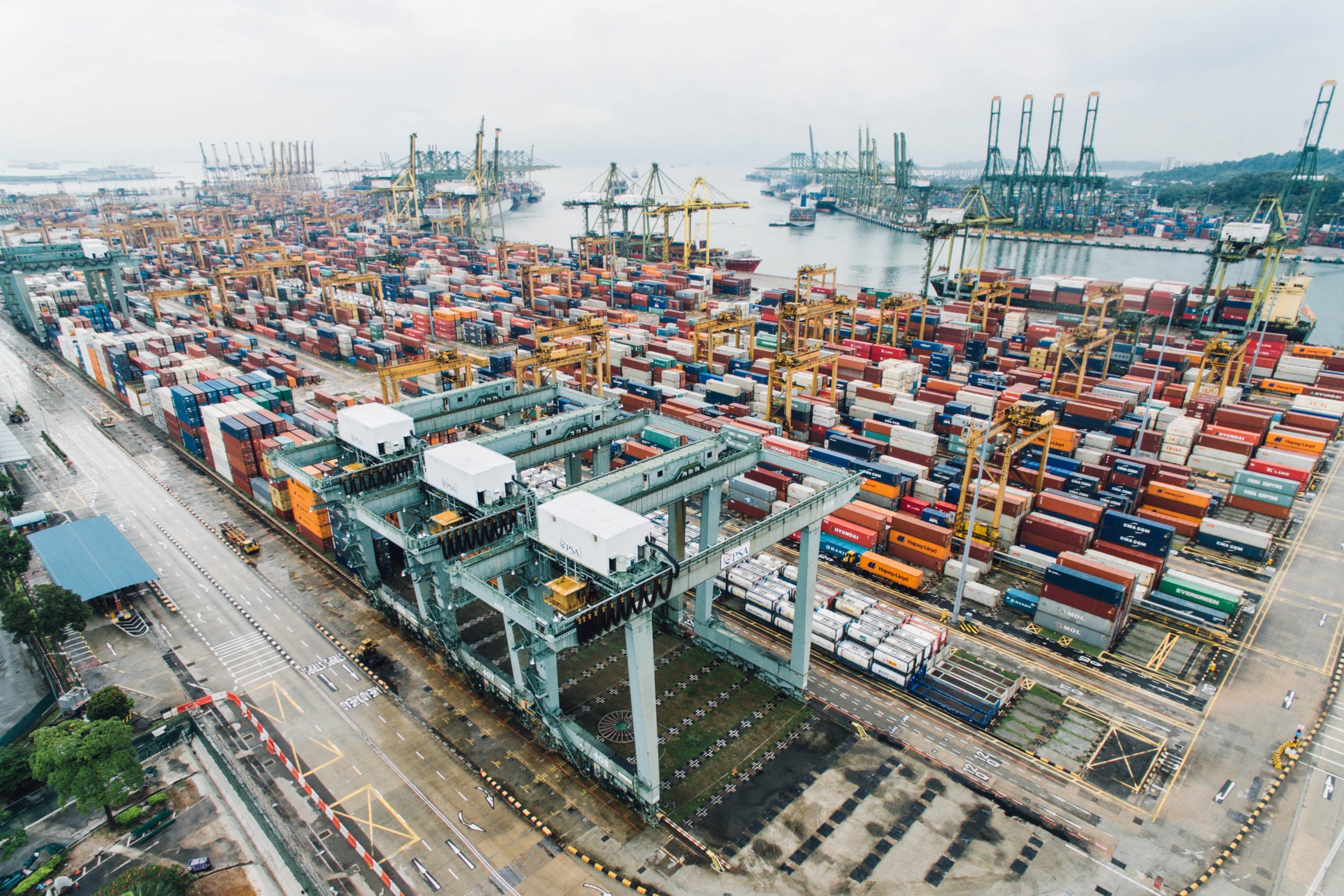
The global economy depends on a vast network of mines, factories, ports, shipping routes and energy supplies stretching across different countries. Much of this trade passes through a small number of maritime routes. The Strait of Malacca, the South China Sea, the Strait of Hormuz, the Suez Canal and other chokepoints connect the main centres of production with sources of energy and raw materials. This has become increasingly important as the rivalry between the United States and China grows. The US remains the dominant military power behind the international maritime system that developed after the Second World War. China, after decades of rapid industrial growth, has become heavily dependent on the same global supply chains while also developing its own economic and military power.
Southeast Asia sits at the centre of this changing situation. The Strait of Malacca and the South China Sea carry some of the world's most important energy, manufacturing and technology supply chains. At the same time, countries such as Malaysia, Indonesia, Vietnam and the Philippines are increasingly caught between their economic relationship with China and the continuing military influence of the United States.
Competition, Monopoly and Imperialism
Competition is built into capitalism. Every capitalist organisation is under pressure to expand, cut costs, increase productivity and defend its market against its rivals. Over time, however, this competition also produces its opposite — the concentration of capital into ever larger corporations, banks and monopolies.
Monopoly does not end competition. It pushes competition onto a larger scale.
As capital accumulates, the biggest corporations increasingly search beyond their national borders for profitable investment, new markets, cheaper labour, raw materials and strategic resources. The state becomes increasingly important in defending these interests abroad. This is one of the foundations of modern imperialism.
It would be too simple to say that capitalism expands abroad only because workers cannot afford to buy everything they produce. Low wages and restricted consumption are certainly part of capitalism's contradictions. But the deeper pressure comes from accumulation itself. Capital must constantly find profitable outlets. It must expand or lose ground to competitors.
We have seen different forms of this competition throughout the history of capitalism.
In the period leading towards the World Wars, the major industrial powers competed over colonies, markets, raw materials, and spheres of investment. Oil, rubber, and iron ore had become essential for modern industry. Because established empires like Britain and France already controlled vast colonial territories, later-developing capitalist powers—primarily Germany and Japan—sought a redivision of the globe to advance the interests of their ruling classes. This inherent need for capitalist expansion became the fundamental driving force behind inter-imperialist conflict.
However, the 1917 Russian Revolution, led by Lenin and Trotsky, successfully broke the weakest link in the imperialist chain. It was intended not as an isolated national event, but for a global socialist transformation, inspiring massive uprisings like the German Revolution of 1918–1923.
But the defeat of these European revolutions left the young Soviet workers' state isolated and allowed a conservative bureaucracy headed by Stalin to usurp political power. To justify their abandonment of socialist international revolution, the bureaucracy adopted the nationalist theory of "Socialism in One Country". It played a counter-revolutionary role in derailing revolutionary opportunities abroad. In China in 1925–27, the Communist Party was subordinated to the bourgeois Kuomintang with disastrous consequences. In Germany, the Comintern's policy divided the workers' movement at the decisive moment of Hitler's rise. These defeats drove a wedge through the international working-class movement, creating the breathing room in which capitalism could survive.
Decades later, the collapse of the Stalinist regimes in Eastern Europe and the Soviet Union in 1989–91, followed by capitalist restoration, was a massive, historic victory for Western imperialism. For a time, no other power could seriously challenge the United States on a global scale. Washington stood at the centre of the capitalist world economy. Institutions such as the World Trade Organization and the IMF helped impose the rules of the global market, while US military power stood behind this economic order.
China's 1949 revolution overthrew landlordism and capitalism and laid the basis for a nationalised planned economy. But it did not establish democratic workers' control: a Stalinist bureaucracy held political power from the outset. Mao's victory went beyond the CCP's formal two-stage perspective of a separate capitalist-democratic stage before socialism. The resulting planned economy made major social and industrial advances, despite bureaucratic mismanagement and the absence of workers' democracy.
From the late 1970s, the bureaucracy under Deng Xiaoping promoted market reforms, foreign investment and special economic zones. This process accelerated in the 1990s. It opened the Chinese working class to intensified exploitation by both foreign and domestic capital, while the CCP retained political power and a powerful state-owned sector. The CWI has described the resulting economy as a peculiar form of state capitalism. Its recent discussion also stresses the hybrid and contradictory character of the state, rather than treating China as identical to a conventional capitalist power.
AI, Supply Chains and Imperialist Rivalry
Competition over AI and its supporting infrastructure has become an important arena of US–China rivalry.
The US and China are now locked in a desperate imperialist struggle to monopolise the physical supply chains that make AI possible. Modern capitalism has divided production across the world. A single commodity may depend on raw materials extracted in one country, components manufactured in several others, assembly somewhere else and final sale thousands of kilometres away. Control over these networks therefore gives enormous economic and strategic power.
Today, a very large share of global trade is concentrated through a few narrow maritime spaces. These straits and canals are the points where supply chains, energy flows and imperialist rivalry intersect.
Four routes are particularly important: the Strait of Malacca and the South China Sea, the Strait of Hormuz, the Suez Canal, and the Panama Canal.
The Strait of Malacca and the South China Sea
The Strait of Malacca developed historically as the main maritime connection between the Indian Ocean and East Asia. Today, it is one of the most important corridors in the global economy, carrying energy and raw materials towards the major industrial centres of East Asia while manufactured goods travel in the opposite direction towards Europe, Africa and the Middle East.
This makes Malacca different from the Strait of Hormuz. Hormuz is primarily the exit route for oil and liquefied natural gas produced in the Persian Gulf. Much of that energy, when destined for China, Japan and South Korea, then travels across the Indian Ocean and through the Strait of Malacca. But Malacca also receives oil from other sources, including Russia and Africa. In the first half of 2025, before the major disruption of Hormuz in 2026, EIA data recorded around 23.2 million barrels of oil per day passing through Malacca, compared with 20.9 million barrels per day through Hormuz.
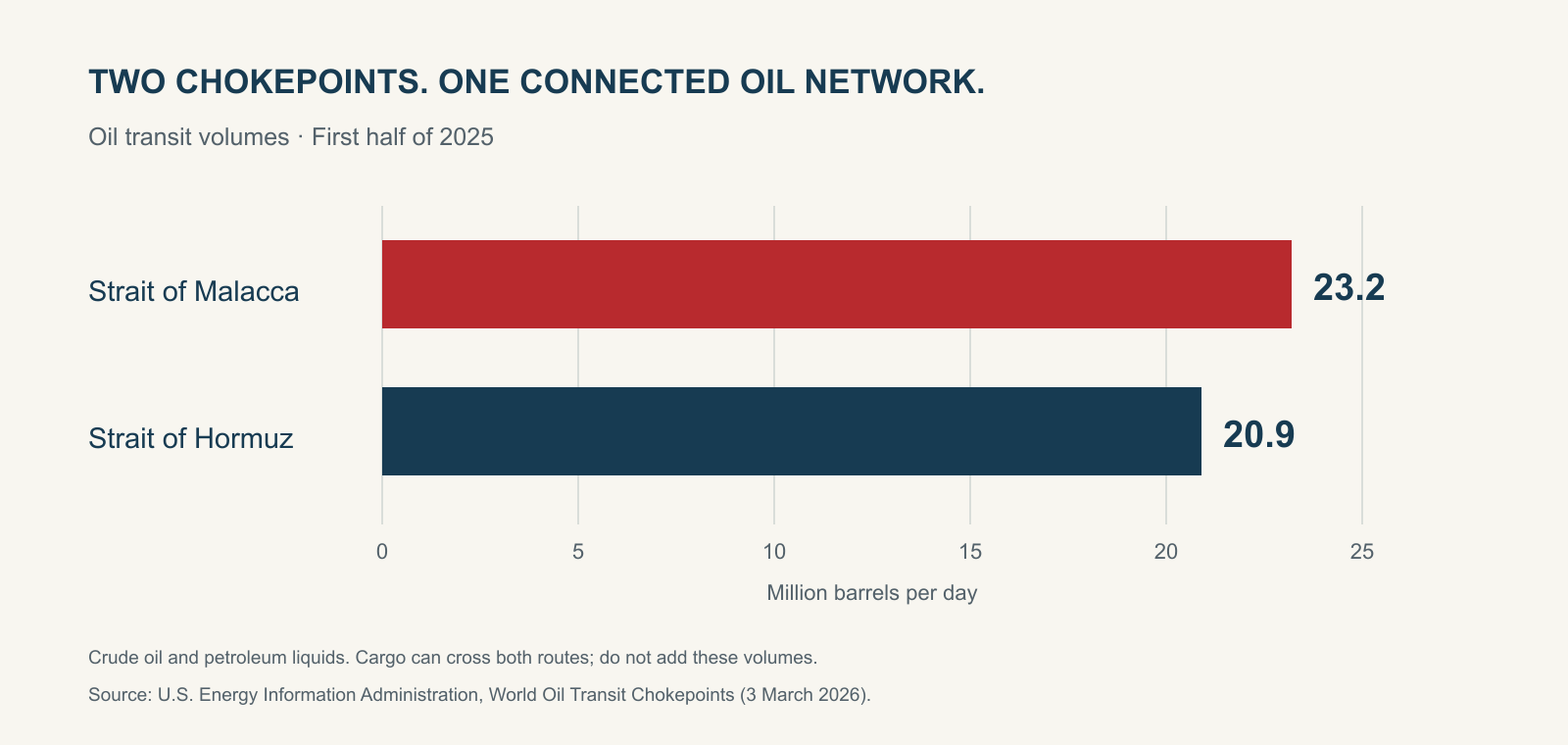
Malacca is therefore more than an energy chokepoint. It is a major two-way artery of global production. Oil, gas and other raw materials travel eastwards towards the factories of China, Japan, South Korea and Southeast Asia, while electronics, machinery, components and other manufactured commodities travel westwards towards international markets. In 2024, more than $2.4 trillion worth of goods passed through the Strait, equivalent to around 21% of global maritime trade.
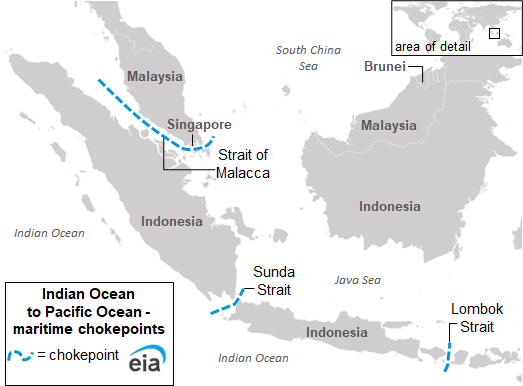
China has no equivalent route capable of replacing Malacca at anything close to the required scale. Ships can avoid Malacca by passing through Indonesia's Sunda Strait, or, particularly for larger vessels, through the deeper Lombok Strait and then the Makassar Strait. In an extreme case, vessels could travel much farther south around Australia. But these routes increase distance, fuel use, shipping costs and journey times. Sunda is also too shallow for some very large vessels. They are therefore alternatives, but not direct substitutes for Malacca's combination of capacity, location and short transit distance.
This is the material basis of China's “Malacca Dilemma.” It opens directly into the South China Sea, linking this economic dependence to the wider struggle over naval power, territorial control and the security of global supply chains.
In a major conflict, the United States and its allies could potentially disrupt one of the most important supply routes feeding China's industrial economy.
This vulnerability extends further north through the First Island Chain, a geographical arc central to US strategy since the early Cold War, running from Japan through Taiwan and the Philippines towards Borneo. It was reinforced by Obama’s “Pivot to Asia” announcement in 2011, which aimed to strengthen US military presence and alliances in the Asia-Pacific. In 2012, the Pentagon announced a goal of basing 60% of US naval ships in the Pacific by 2020.
The Belt and Road Initiative
The Belt and Road Initiative, launched in 2013, partly addressed this problem, although it also responded to wider economic pressures.
After the 2008 global financial crisis, Beijing introduced a four-trillion-yuan stimulus package and poured credit into infrastructure, housing and industry. This helped sustain growth, but it also created excess productive capacity and accumulated capital searching for new outlets. The BRI offered Chinese companies new markets, investment opportunities and infrastructure projects abroad.
At the same time, it allowed Beijing to diversify its trade and energy routes.
The China-Pakistan Economic Corridor linked western China more closely to Gwadar on the Arabian Sea, while oil and gas pipelines through Myanmar connected the Bay of Bengal directly to Yunnan. Chinese banks and corporations also financed, constructed or acquired stakes in ports such as Gwadar, Hambantota in Sri Lanka and Piraeus in Greece.
These projects gave Chinese capital greater influence over the infrastructure through which international trade moves while reducing, to some extent, dependence on maritime chokepoints such as Malacca.
The Limits of the Overland Alternative
However, these cannot replace maritime trade. The Myanmar crude-oil pipeline, for example, can carry around 440,000 barrels per day, while China imported about 11.6 million barrels of crude oil per day in 2025. Even at full capacity, it could therefore replace only a small proportion of China's oil imports. The proposed oil route from Gwadar across Pakistan into western China has also not developed into an operational corridor capable of replacing large-scale maritime imports.
The basic problem is one of capacity and cost. A single Very Large Crude Carrier can transport roughly 1.9 to 2.2 million barrels of oil. Railways, roads and pipelines cannot easily move the same quantities at the same cost.
Overland routes also have their own political and security vulnerabilities. CPEC projects have faced delays and repeated attacks on Chinese interests in Pakistan, particularly in Balochistan, while the civil war in Myanmar has created continuing uncertainty around Chinese infrastructure and pipelines.
China therefore remains heavily dependent on the sea. In the first half of 2025, China accounted for around 48% of the oil passing through the Strait of Malacca. Its factories depend on imported energy and raw materials arriving by sea, while Chinese commodities and capital increasingly move through the same maritime network towards international markets.
This continuing dependence helps explain why China's economic expansion has also been accompanied by a major expansion of naval power.
From Economic Expansion to Maritime Power
The People's Liberation Army Navy has expanded from a mainly coastal force into a major blue-water navy capable of operating far beyond the Chinese mainland. At the same time, Beijing has transformed reefs in the Spratly Islands into artificial islands with runways, harbours, radar, communications and missile infrastructure. These bases extend China's military and surveillance reach much farther into the South China Sea.
But China's present strategy does not rely mainly on open naval confrontation. Much of the day-to-day enforcement is carried out by the China Coast Guard and maritime militia. Coast Guard vessels maintain regular patrols, obstruct ships, challenge drilling and fishing activity, use water cannons and blocking manoeuvres, and increasingly act as though Chinese jurisdiction already exists across disputed waters.
This is often described as grey-zone coercion: applying continuous pressure below the level of conventional war. The pattern is gradual. China establishes a presence, strengthens infrastructure, increases patrols, applies its own regulations and makes access increasingly difficult for neighbouring states. Over time, this can produce a form of de facto control even where China's legal claims remain disputed.
China's 2021 Coast Guard Law reinforced this direction by giving the Coast Guard a clearer domestic legal basis to defend what Beijing defines as Chinese sovereignty and maritime rights. The 2023 Standard Map, meanwhile, again displayed the ten-dash formulation, but the more important development has taken place on the water rather than on paper.
China is using economic and military power in the South China Sea to defend corporations, energy supplies, investment networks and strategic interests. China's effort to establish a regular presence across the South China Sea is not confined to artificial islands or military exercises. It increasingly comes into direct conflict with the economic activities of neighbouring Southeast Asian states, particularly where China's dashed-line claims overlap with their Exclusive Economic Zones.
The pattern is similar across the region. Chinese Coast Guard vessels maintain regular patrols, shadow drilling and survey ships, challenge fishing activity and demonstrate that Beijing considers these waters to fall within its sphere of authority. The intensity, however, differs from country to country.
The Philippines: Closer Military Integration with the US
Second Thomas and Sabina Shoals
The confrontation with the Philippines has become considerably more direct.
At Second Thomas Shoal, the Philippines maintains a small military presence aboard the grounded warship BRP Sierra Madre. Manila deliberately grounded the vessel there in 1999 and has since depended on regular resupply missions to maintain its position.
China has increasingly attempted to obstruct these missions using Coast Guard vessels, water cannons, blocking manoeuvres and collisions.
A serious confrontation occurred in June 2024. During a Philippine resupply mission, Chinese Coast Guard personnel boarded Philippine boats. The Philippine military said Chinese personnel used bladed weapons and other equipment, damaged the vessels and seized equipment and firearms. A Filipino sailor suffered serious injuries and lost a thumb. Beijing rejected Manila's account and accused the Philippines of provoking the confrontation.
Tensions also developed around Sabina Shoal in the same year. Chinese and Philippine Coast Guard vessels collided there. Manila accused Chinese vessels of deliberately ramming and damaging two Philippine ships, while Beijing blamed the Philippine side for causing the collision.
By 2025, Chinese Coast Guard patrols had become increasingly concentrated around Sabina and Scarborough Shoals, showing how sustained Coast Guard presence has become one of Beijing's principal methods of asserting its claims without deploying the navy directly.
China's pressure in the West Philippine Sea has hardened public opinion in the Philippines. A May 2026 Pulse Asia survey, commissioned by Stratbase and reported by the University of Technology Sydney, found that 86% of respondents favoured working with like-minded countries to defend the West Philippine Sea; 84% selected the United States as a partner. Such findings have provided political support for the Marcos government's deeper military cooperation with the US and other regional allies.
The result is a contradiction: Chinese pressure has strengthened popular demands to defend Philippine sovereignty, while also pulling the country more deeply into the wider US–China rivalry.
Vietnam: Bamboo Diplomacy
Vietnam has adopted a different strategy.
Hanoi describes its foreign policy as “bamboo diplomacy”: maintaining relations with competing powers while avoiding firm alignment with any one bloc. Vietnam upgraded relations with the United States to a Comprehensive Strategic Partnership in 2023, while maintaining the same highest diplomatic status with China and deep economic ties with Beijing.
At the same time, Vietnam has been strengthening its own position in the South China Sea. Since around 2021, Hanoi has rapidly expanded land reclamation on its Spratly outposts. By May 2026, AMTI estimated that it had created about 2,771 acres of artificial land, making Vietnam the second-largest island builder in the Spratlys after China. Barque Canada Reef, now its largest outpost, includes an approximately 8,000-foot runway and expanded harbour and military infrastructure.
Vietnam is combining diplomatic balancing with independent military preparation. It opposes China's expansion and strengthens its own territorial position, but unlike the Philippines has so far avoided placing itself openly within a US-led military strategy.
Indonesia: Economic Cooperation Without Accepting China's Claims
Indonesia has also attempted to balance economic relations with China against its maritime interests. Jakarta insists that it has no overlapping territorial claim with China in the North Natuna Sea and rejects the legal basis of China's dashed-line claims.
However, during President Prabowo Subianto's visit to Beijing in November 2024 the two governments issued a joint statement referring to joint development in areas of overlapping claims. This caused controversy in Indonesia because critics argued that the wording appeared to acknowledge the existence of Chinese claims that Jakarta had consistently said had no legal basis.
Indonesia's Foreign Ministry quickly clarified that the agreement did not recognise China's claims or alter Indonesian sovereignty and jurisdiction in the North Natuna Sea. The controversy came alongside much closer economic cooperation. During the same visit, Chinese and Indonesian companies signed around US$10 billion worth of agreements covering areas including green energy, technology, lithium batteries, photovoltaics and mineral processing.
Malaysia: Quiet Diplomacy and Continued Economic Ties
Malaysia faces a similar contradiction.
China remains Malaysia's largest individual trading partner. In 2025 it held that position for the 17th consecutive year. At the same time, Chinese Coast Guard vessels repeatedly operate inside areas Malaysia considers part of its Exclusive Economic Zone, particularly around the Luconia Shoals and offshore energy developments near Sarawak.
The tension became particularly visible around the Kasawari gas field and neighbouring Petronas operations. Chinese vessels have patrolled close to Malaysian production platforms, while Beijing has formally objected to Malaysian oil and gas exploration in waters covered by China's own maritime claims. Kasawari alone is estimated to contain around 10 trillion cubic feet of gas.
Malaysia has generally responded differently from the Philippines. Rather than publicly escalating each confrontation, successive governments have preferred negotiation and quieter diplomatic channels while maintaining economic relations with China.
But this should not be confused with accepting Beijing's claims. Prime Minister Anwar Ibrahim has repeatedly stated that Petronas will continue exploration and production within Malaysia's EEZ despite Chinese objections. Malaysia's position has therefore been to continue exercising its economic rights while attempting to prevent the dispute from damaging the wider relationship with Beijing.
Building a Chinese Sphere of Influence
There is a historical comparison with the rise of the United States.
As the US developed into a major capitalist power during the nineteenth and early twentieth centuries, it increasingly sought to exclude European imperial powers from the Western Hemisphere. Through the Monroe Doctrine and later US interventions, the Caribbean and Central America increasingly became treated as a strategic sphere in which Washington expected to be the dominant power.
China is moving towards a comparable position in East Asia.
From Beijing's standpoint, US naval forces operating close to the Chinese coastline, military alliances with Japan and the Philippines, support for Taiwan, and US bases along the First Island Chain all limit China's ability to determine the strategic conditions surrounding its own economy. China therefore seeks not simply to defend its coastline, but to push US military influence further away and establish itself as the dominant regional power.
From a Marxist perspective, this is an important distinction. China's actions cannot be understood only as a defensive reaction to US pressure. US military dominance is a threat, but China is also an expanding capitalist power developing its own sphere of influence.
This material struggle is accompanied by an ideological argument based heavily on history.
The Chinese government argues that Chinese activity in the South China Sea stretches back more than 2,000 years. Its official statements cite historical navigation, naming of islands, fishing activity, administrative records and accounts from the Ming and Qing periods as evidence of longstanding Chinese rights in the region.
This argument remained central even after the 2016 arbitration. The tribunal ruled that Chinese claims to historical rights over resources inside the nine-dash line had no legal effect where they exceeded the maritime rights established under UNCLOS. Beijing rejected the ruling and continues today to maintain that China possesses both sovereignty over the South China Sea islands and historic rights in the surrounding waters.
These historical claims also fit into Xi Jinping's wider political language of “national rejuvenation.”
Xi repeatedly presents modern Chinese history as a movement from the humiliation and domination imposed by foreign powers after the nineteenth century towards the restoration of a strong and independent China. Officially, “national rejuvenation” is framed as overcoming this historical weakness and building China into a powerful modern state.
It would be too strong to say that Beijing officially defines national rejuvenation as restoring China as the “central power of Asia.” That is an interpretation rather than China's stated position. But the ideology provides an important political framework through which the Chinese ruling class can present the expansion of its regional power as the recovery of rights supposedly lost during the “Century of Humiliation.”
Similar uses of history can be seen in other nationalist projects. Hindutva currents around the RSS and BJP have promoted the idea of Akhand Bharat, or an undivided greater India based on a historical-cultural conception of the subcontinent. In Israel, sections of the governing right invoke biblical and historical claims to “Judea and Samaria” in support of Israeli sovereignty and settlement expansion in the occupied West Bank.
The political forms are different, and the histories should not simply be equated. But the method is comparable.
A New Phase of Capitalist Crisis
The war in Ukraine from 2022 accelerated the fragmentation of the post-Cold War economic order. Western sanctions on Russia, the redirection of Russian trade towards Asia, tighter military blocs, technology restrictions and attempts to secure strategic supply chains increasingly pushed trade and investment along geopolitical lines.
The war in Gaza and wider conflict in the Middle East intensified this process. From late 2023, Houthi attacks disrupted shipping through the Red Sea and Suez Canal. By 2026, conflict involving the US, Israel and Iran had brought similar pressures to the Strait of Hormuz. Major maritime chokepoints have therefore become increasingly entangled with military conflict.
The effects are visible throughout global supply chains. Red Sea attacks forced many shipping companies to reroute vessels around the Cape of Good Hope, increasing voyage times, fuel costs and freight rates. The disruption reached Southeast Asia, where irregular arrivals contributed to severe congestion at Singapore and other regional ports in 2024.
Sanctions and the Shadow Fleet
Sanctions have also reorganised maritime trade through the growth of the so-called shadow fleet — older tankers transporting sanctioned oil, particularly from Russia and Iran, through opaque ownership structures, questionable flags, AIS manipulation and ship-to-ship transfers.
Waters off Malaysia, particularly around Johor and the eastern approaches, have become important transfer and anchorage areas. Tankers carrying Iranian, Russian and other sanctioned crude frequently use these waters before cargoes continue towards markets including China.
These networks expose another contradiction of sanctions. They can raise costs and redirect trade, but they rarely stop commodities from moving. Instead, capital develops new intermediaries, ownership structures, financial channels and transport routes to circumvent restrictions.
The fragmentation of the world economy therefore does not mean the end of globalisation. Global supply chains are being reorganised around competing political and military blocs, becoming more expensive, indirect and increasingly militarised.
A Socialist Alternative
The maritime conflicts and the fragmentation of global supply chains arise from a capitalist system organised around competition, accumulation and profit.
Today's world economy remains deeply integrated. Supply chains connect mines, factories, ports, shipping companies, energy networks and workers across continents and oceans. Yet this enormous productive network remains divided between private corporations and competing capitalist states.
The United States seeks to defend the global order it has dominated since the Second World War. China, as its economic and military power grows, seeks greater control over markets, trade routes, resources, technologies and strategic territory. The struggle between them increasingly turns the infrastructure of the global economy itself into an arena of imperialist competition.
Neither the US-led order nor the expansion of Chinese state capitalism offers an alternative for the working class. The alternative lies in the international organisation and solidarity of the working class.
A socialist alternative would mean democratically nationalising and placing under workers' control the major means through which the maritime global supply chain operates: the ports, shipping companies, shipyards, logistics networks, warehouses, rail and transport systems, energy infrastructure and other strategic industries on which international trade depends.
These industries would have to be democratically controlled and managed by workers and society, with decisions over investment, production, trade and the use of resources made according to social and environmental needs rather than the profitability of competing corporations.
A genuinely socialist global economy cannot be organised through competing national states fighting over ports, resources and shipping lanes. It would require cooperation between workers across countries and the democratic planning of production, energy, transport and trade on an international scale. The very global supply chains that capitalism has created demonstrate that such international coordination is materially possible. The problem is not the international character of production, but who owns it, who controls it and for what purpose it is organised.
Only by taking the major productive forces and the infrastructure of global trade out of the hands of competing capitalist interests can the enormous productive capacity created by modern capitalism be used for the benefit of society rather than becoming another source of exploitation, economic coercion and war.
Feature photo: CHUTTERSNAP / Wikimedia Commons (CC0), Singapore, May 2017.