

There is no shortage of profits in Malaysia’s banking industry. In 2025, some RM51 billion in pre-tax profits was recorded, up 13% from the previous year. The CEO of Public Bank reportedly earns RM177,000 in a single day.
At the same time, confronted with sky-high cost of living and an uncertain future, over 15,000 National Union Bank Employees (NUBE) members are still waiting for the resolution of the 20th Collective Agreement (CA20), stalled for nearly 3 years and whose intended term ends in less than 3 months.
Surely the bosses can afford, as demanded in CA20, a 22.4% wage increase (rather than a measly 9%) and a reduction of the normal workweek from 39 to 35 hours. Surely, too, they can afford a two-month Festival Aid (FA) every year. But just because they can, it does not mean they will. Objectively, the capitalist profit motive and market logic demand that they keep wages to a minimum, especially so as the crisis of capitalism deepens. Subjectively, they have every incentive to resist permanent gains for workers unless doing so becomes more costly than conceding, no less when industrial action and profit disruption are on the line.
This also explains the heavily contested democratic demands in CA20, particularly those against attempts by the Malayan Commercial Banks’ Association (MCBA) to dismantle protections inherited from CA19 on the questions of union rights and social dialogue. Strengthening these would shift greater influence over workplace and industrial policy towards organised workers.
In short it is the balance of class forces that decides if capital should concede to labour — or else double down on resistance, drawing on the law, the courts, the police and the wider machinery of the state to contain the workers’ growing anger and militancy.
“Corporate mafia” and class character of the state
When the ongoing #BankTipuKita campaign was launched, NUBE leaders asked: Has the ‘corporate mafia’ turned the banks, some of which were supposed to function as socially responsible GLCs, into ‘monsters’ under the watch of the Madani state?
There is no question about the gangster methods and ‘culture of fear’ wielded by the bosses against workers who actively participate in collective struggle. Over the years, NUBE has reported repeated cases of union-busting, intimidation and discrimination on the streets and in the workplace. At some actions during the 2024 wave of peaceful pickets, unusually heavy police presence was reported. Union organisers have been punished by means of career sabotage and, in some cases, outright suspension if not dismissal. More recently, NUBE members wearing the #BankTipuKita badge have faced instructions to remove it, show-cause letters, threats of disciplinary action and, according to NUBE, dozens of suspensions.
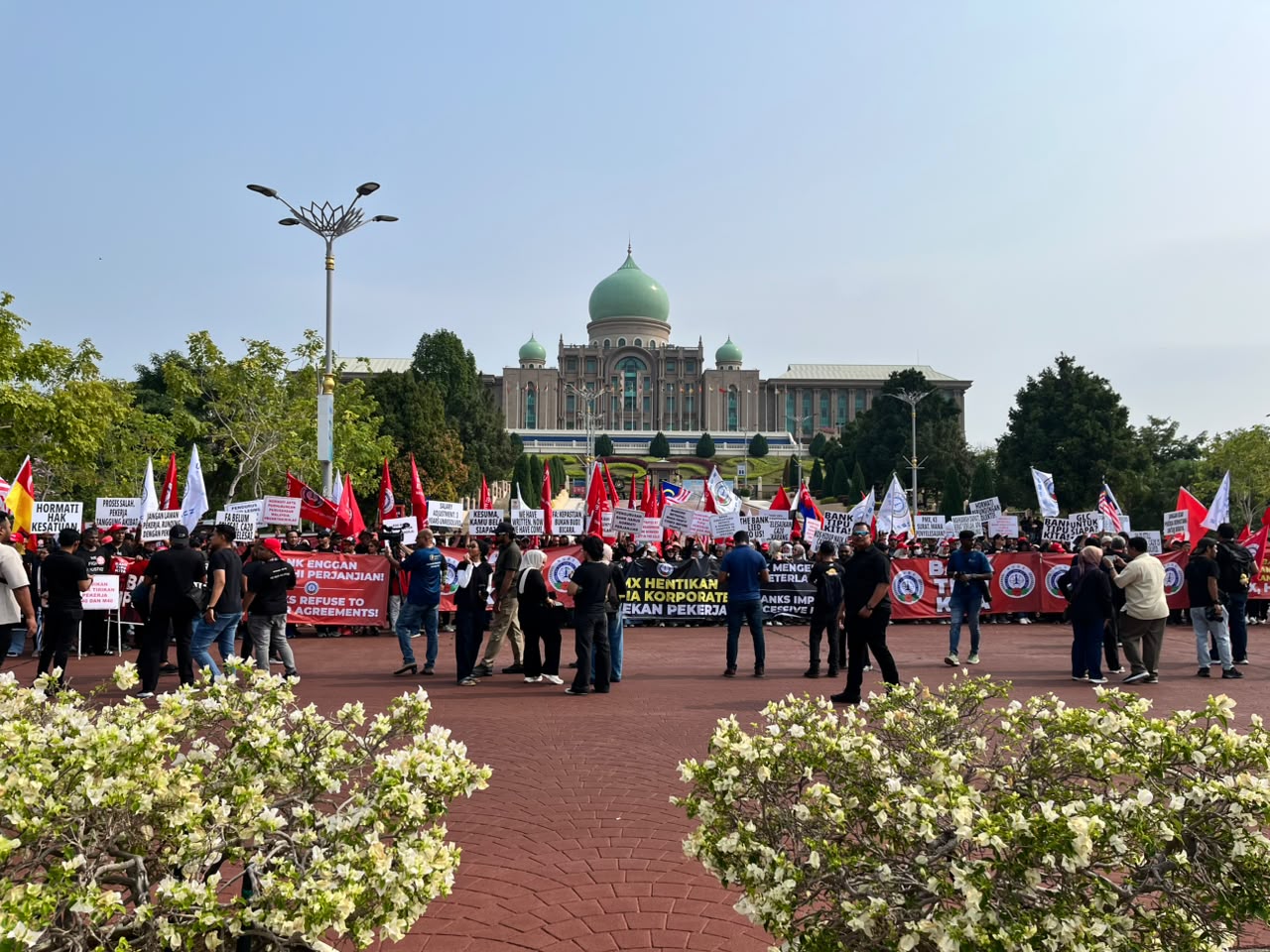
Nor is there question about the class character of the state. In April 2024, former Labour Minister Steven Sim bypassed the MCBA–NUBE Standing Committee established in CA19 and referred the CA20/FA disputes to the Industrial Court. Here, direct state intervention did more than prolong the disputes; it legally restricted industrial action over them in the 22 months that followed. Not until February this year were the referrals quashed by the High Court in NUBE’s successful judicial review. MCBA was ordered back to the negotiation table, a decision it appealed immediately. Just 7 months later, on 26 September, MCBA successfully asked Justice Norliza Othman for an interim stay, pending appeal next March; until then the High Court order compelling renewed FA negotiations is suspended. Meanwhile CA20 talks remain deadlocked with just 16 of 47 articles having been agreed upon. In all this, NUBE has sent 43 letters to PM Anwar, who also serves as Finance Minister, yet not once has he replied.
On this note, NUBE’s latest slogan urging its members ‘not to merely watch the banks, but to watch those in power’ deserves closer examination, for it raises the question whether those who own the banks can be neatly separated from ‘those in power’ after all. The experience of NUBE has shown us that the state is never neutral, and for which class’s interests it fundamentally stands — it exists to defend the right of the capitalist class to exploit the labour of the working class.
That the question of power has come to the fore demonstrates to some extent the ongoing politicisation of the struggle. As the state gives away more of its class character, it poses before us more sharply than ever our strategic and organisational limits. Do we keep returning to the negotiation table when the bosses have clearly been acting in bad faith with full backing of the state, or do we begin to consider serious industrial action, such as a strike? Do we keep placing our hope in the existing political parties to champion the rights of workers, or is it finally time we flew our own flags?
Advancing the struggle
Despite the ministerial referrals that legally restricted industrial action over the CA20/FA disputes, 2024 alone recorded dozens of pickets across the country, the biggest being the September Mega Picket at Menara Maybank. As a workaround, many of these were not framed as specific CA20/FA pickets, but covered a broader range of issues including sexual harassment and union busting. Other unrestricted forms of mobilisation such as protests and campaigning were carried out, with 2025 featuring two major national public demonstrations: a 1,000-strong Labour Day rally outside of KESUMA in Putrajaya, and a November march to Bank Negara involving hundreds.
MCBA certainly found it deeply concerning and reacted no less swiftly when workers took to the streets during the nationwide pickets and protests. Being non-strike actions, however, they stopped short of withdrawing labour, such that their direct economic impact remained limited. Strike action, on the other hand, is as NUBE puts it: ‘When workers stop, the country stops.’
A strike is not just disruptive and costly. It is one of the barest expressions of workers acting as a class. By collectively refusing to work, workers reveal in practice where their real power lies. The banks may own the buildings, technology and capital, but without workers none of it functions. The significance of strike action therefore goes beyond the immediate pressure it places on profits. Through collective struggle, workers can overcome fear and isolation, gain confidence in their own strength and begin to view the power of the bosses as neither natural nor absolute. Every picket, demonstration and collective action that brings workers into struggle can prepare the ground for higher levels of organisation and consciousness.
Nevertheless, the industrial struggle driven by the working class must be linked to its own distinct political power. Without a political vehicle led by the working class — grounded in a programme of the working class’s own struggle — we will continue to be victimised, deceived, and betrayed by politicians who consistently reveal their allegiance to employers, CEOs, and the upper echelons of leadership, all of whom are lulled by excessive wealth. The government led by PH, which had long championed the slogan of ‘reform’, has betrayed its own cause, leaving its own supporters to bear the brunt of this betrayal.
If workers can and do organise independently against the bosses industrially, why depend politically on parties tied to capitalist interests, be it PH, BN, PN, or MUDA? The experience of NUBE’s struggle consequently raises a wider question for the whole working class: whether the principle of independence already expressed through trade unions should also find political expression through an independent mass workers’ party.
The wealth exists. The workers who create it have the power to fight for it. What is needed now is the widest possible unity and mobilisation of bank workers alongside the broader working class, linking the struggle for better wages and conditions to the struggle for collective power and an independent political voice.
To this end, Jaringan Solidariti Pekerja and Sosialis Alternatif stand in solidarity with all NUBE members and bank workers across the country. We call on all trade unions and workers’ organisations as well as youth organisations to join and support the struggle. Together we demand, with no further delay:
- Conclude CA20 with real gains for workers — including NUBE’s demand for at least a 22.4% upward adjustment across the salary scales and a reduction of the normal working week from 39 to 35 hours with no loss of pay.
- Settle the FA dispute and guarantee it as a contractual right, including NUBE’s CA20 demand for an annual payment equivalent to two months’ basic salary — not reduced, capped or left to discretionary ex gratia payments.
- Defend and extend trade-union and democratic rights. No erosion of the protections won under CA19. Guarantee workers’ rights to representation, collective bargaining, social dialogue and collective industrial action, free from employer intimidation or state interference.
- End union-busting, intimidation and victimisation. Withdraw disciplinary action against workers targeted for legitimate union activity, and reinstate workers unjustly suspended or dismissed with full restoration of wages, benefits and seniority.
- Justice for workers facing sexual harassment, bullying and discrimination. Resolve all outstanding complaints through transparent and impartial procedures with full union representation, protect complainants and witnesses against retaliation, and guarantee a safe and dignified workplace for all.
- Defend jobs, safety and working conditions against restructuring and technological change. Automation, reskilling and restructuring must not be used to cut jobs, wages or union rights. Workers and their union must have a decisive say over these changes, with paid training, stronger occupational safety and health protections, and guarantees against displacement.
- Extend the wage struggle beyond the banking sector. While supporting the immediate fight for RM3,100 as a minimum floor for bank workers, we call on the wider trade-union movement to fight for a national minimum wage of RM20 an hour, rising with the cost of living.
- Cut the salaries of CEOs and executives to the level of ordinary skilled workers. Excessive salaries lead to a disregard for the interests and needs of workers. The leadership of the financial industry must be overhauled and led by representatives democratically elected by the working class — representatives who can be removed from their positions at any time if they fail to act in the interests of ordinary workers.
- Open the account books of banks and financial institutions to public scrutiny and worker oversight. Disclose all fund flows, investments, profits and wealth accumulation to expose hidden transactions, malfeasance and the vested interests dominating the national financial system.
- Place the finance and banking industries under working-class management. The working class, led by its organisations and representatives, must have the power to manage the economy for the benefit of workers, rather than for the profit of CEOs, the capitalist class and the elite.
- Build a mass workers’ party and fight for Socialism! Build a political movement that represents the interests of the working class as a whole and strengthens the struggle for an economic system and society that does not favour the elite and the capitalist class, but is instead democratically controlled, planned and determined by the working class.